Choose the desert experience before choosing the tour
“Morocco desert” can mean a real Saharan sand sea, a rocky landscape outside Marrakech, or a long scenic drive through the south. Name the destination on the itinerary before comparing prices. The two best-known dune areas are Erg Chebbi by Merzouga and Erg Chigaga near M’hamid. Morocco’s tourism board describes Merzouga as a gateway to Erg Chebbi’s dunes, palm groves and desert walks; the southern Ouarzazate–Zagora region offers a different route through valleys and desert-edge landscapes. 1 2
If you mainly want the postcard image of a broad dune field, choose Merzouga. It is the more straightforward option for first-time visitors: road access reaches the village, and tours connect visitors from there into the dunes. Erg Chebbi remains a working, visited landscape, not an empty movie set; expect to encounter other camps and excursion vehicles around popular areas. A reported on-the-ground account describes both the memorable dune scenery and the tracks and vehicle activity visitors may see. 3
Choose Erg Chigaga when a less accessible, more remote excursion is the point. It is approached from M’hamid and requires a 4x4 desert transfer; confirm the actual off-road segment and who supplies the vehicle before booking. Do not choose it because a tour page calls it “the biggest” or “wildest” without explaining the journey and time involved. For many itineraries, it is the transfer and isolation—not a guaranteed empty landscape—that distinguish this option. 2 4
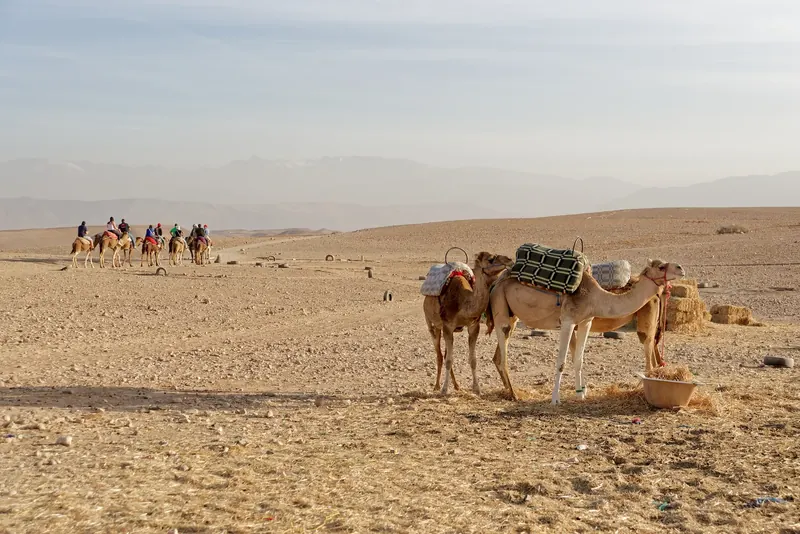
Agafay, near Marrakech, is a useful alternative when you have only a free afternoon or want an overnight outside the city without a long southern drive. It is stony and arid, not a Sahara dune destination. Ask the operator to describe the actual terrain and location rather than relying on the word “desert.”
Make the route match the time you have
Treat the Sahara as a multi-day part of your trip. A Marrakech-to-Merzouga journey crosses long distances and mountain or valley roads; a same-day out-and-back leaves little meaningful time at the dunes and makes the road itself the day’s main activity. The Moroccan tourism board lays out a staged southbound route via Ouarzazate-Zagora-Tinghir and then Errachidia-Midelt-Merzouga, while its destination information highlights the east-side approach through the Middle Atlas. 1 2
A practical Marrakech plan is to travel south with at least one overnight stop en route, spend a night near or in the dunes, then continue onward or return with another overnight. Treat this as a route shape, not a promise of exact drive times: roadworks, weather, stops and the chosen camp transfer change the day. A loop back to Marrakech adds substantial road time; a one-way itinerary ending in Fez or elsewhere may avoid retracing ground, but only if your transport and luggage plan really supports it. Check the current route and service arrangements close to departure.
Starting from Fez or Errachidia can reduce backtracking for some travelers. The tourism board lists Fez among the approach points and gives indicative road distances and times on its route pages, but those are planning references, not guaranteed journey durations. 1 For an independent itinerary, verify intercity coach availability for your dates, the final connection to the village or camp, and the return leg before committing to lodging. Do not assume a train reaches Merzouga: the final stretch is not a rail connection.
If you have only one spare day in Marrakech, choose a nearby outing such as Agafay and be clear-eyed about what it is. If the actual Sahara dunes are your priority, postpone the trip until you can allocate several days. For broader itinerary pacing, see the flexible first-time Morocco itinerary and Morocco road-trip guide.
Pick your transport style
A guided multi-day tour is simplest when you want one booking to coordinate the driver, stops and dune transfer. Ask for a day-by-day itinerary rather than a list of attractions. Check whether the quoted package includes private or shared transport, hotel nights en route, the camp night, meals, luggage transfer and any activities. A camel ride, 4x4 excursion or quad outing may be optional or separately charged; never infer inclusion from a promotional photo. Compare the total door-to-door arrangement, not just the headline duration.
A private driver gives your group control over stops and pace, but does not automatically include a licensed guide at sights, camp arrangements or off-road transport. Confirm who is responsible for each handoff. For Erg Chigaga, clarify the 4x4 transfer origin, duration estimate, baggage limits, waiting arrangements and contingency if conditions disrupt access.
Self-driving can work for travelers comfortable with long rural drives, but it is not the same as driving into open dunes. Park at the agreed meeting point and use a camp or local operator’s arranged transfer for any off-road section. Avoid late arrivals on unfamiliar roads; leave daylight margin, download offline navigation and keep fuel and rest stops realistic. Review the separate Morocco driving guide before choosing this option.
Choose the overnight, not just the label “desert camp”
“Camp” can describe very different stays, from simple tents to more equipped accommodation. Ask for the exact camp name and approximate location, whether it is inside the dunes or at their edge, and how you reach it. Confirm private or shared bathroom, hot-water availability, electricity or charging, bedding, heating, meal arrangements and whether staff remain on site overnight. Amenities vary by property and season, so get answers for the specific date rather than relying on a generic category.
Decide whether you value dune proximity, comfort, quiet, or easy access more. A camp deep among dunes may require a longer transfer and make luggage restrictions relevant. A lodge at the edge can be easier for travelers who prefer a room and vehicle access. Ask if you can leave a larger bag securely at the starting accommodation and take a small overnight bag; agree this in advance.
You do not need a camel ride to visit the dunes. Ask whether the camp transfer can be by 4x4 or on foot, how long the camel segment is, and whether you can decline it without losing the transfer. If traveling with young children, mobility limitations, back discomfort or a strong preference not to ride animals, settle this before booking. A short walk on loose sand can still be strenuous; choose a camp location and activity level accordingly.
Prepare for the desert night and ask better questions
Temperature and comfort change between the sunny afternoon and after dark. Bring a warm layer even for a warm-season trip, a sun hat, sunglasses, sunscreen, closed shoes for hot or loose sand, and a small daypack. Carry essential medication and personal items with you rather than assuming a remote camp has a nearby shop. A headlamp and portable battery can be useful where power is limited; check the camp’s actual charging setup. The exact weather varies, so check a forecast shortly before the trip and follow your guide’s advice.
Before booking, request written answers to these questions:
- Which named destination is this—Merzouga/Erg Chebbi, M’hamid/Erg Chigaga, or Agafay—and where is the overnight stay?
- What is the route by day, where are the overnight stops, and how much time is actually spent at the dunes?
- Is transport private or shared, and what vehicle and transfer are used for the final camp segment?
- Which meals, entrance fees, guiding, activities and luggage transfers are included, and what costs extra?
- What are the cancellation and weather-disruption terms, and how will the operator contact you if plans change?
The U.S. State Department notes that rural tourism and activities may be less regulated than major tourist centers, that medical help can take longer to reach in remote areas, and advises using guarded campgrounds rather than isolated camping. Review current government advice and your travel-insurance evacuation and medical coverage before departure. 5 This is a reason to check who operates your transfer and where you are staying, not a reason to assume a particular camp is unsafe.
For a gentler experience, favor a small group or private itinerary with fewer stops and a full night at the camp. Avoid a program that promises many distant sights in one day without showing the drive plan. Respect the landscape: stay with your guide where routes are not obvious, do not leave litter, and ask before photographing people. If you want assistance coordinating a Morocco itinerary, the Personal Travel Assistant service is available separately; transport, accommodation and activities are provided and charged by their independent suppliers.
A simple decision rule
Pick Erg Chebbi near Merzouga for the classic high dunes and easier road approach. Pick Erg Chigaga if a remote 4x4 journey is itself part of what you want and your schedule supports it. Pick Agafay when you want a short excursion from Marrakech and accept that it is a rocky desert landscape, not the Sahara’s sand seas. Then protect enough time for the road and a proper overnight. That sequence—destination, days, transport, camp—prevents the most common mismatch: buying a “Sahara tour” that is really a hurried transfer or a different landscape than the one you pictured.