Is Bahia Palace worth visiting?
Yes, if you want to understand how a wealthy 19th-century Marrakech residence combined private courtyards, gardens and finely worked interiors. Its strongest appeal is architectural: a walk through tiled open spaces, carved and painted surfaces, and salons around a large marble-paved courtyard. It is not a furnished royal residence with rooms staged as they were when occupied. Expect a route through a portion of a complex that developed over decades, with more attention drawn to surfaces, proportions and light than to furniture. Lonely Planet likewise notes that only part of the complex is available to visitors. 2
The palace sits in the medina near the Mellah, the historic Jewish quarter. It is part of the wider historic fabric of Marrakech, but the UNESCO World Heritage property is the Medina of Marrakesh; do not confuse that city-wide listing with a separate inscription for Bahia Palace alone. UNESCO names Bahia Palace among the later architectural monuments of the medina. 3
Tickets, hours and what to verify
At the time of research, the Moroccan Ministry of Youth, Culture and Communication’s online ticket page lists foreign adult admission at 100 Moroccan dirhams and foreign children ages 7–13 at 50 dirhams. It lists visiting hours as 9:00–17:00. The same page lists different rates for Moroccan citizens and residents and says free entry is granted to people with reduced mobility; check eligibility and the current arrangements directly with the site rather than assuming a particular service or route is available. 1
Prices in older guidebooks and travel pages may be out of date. For example, the independent Lonely Planet page displays an older lower price, while the ministry ticket page shows its current listed tariff. For a practical decision, use the official ticket portal on the day you plan to go, check whether online purchase is operating, and confirm whether your ticket category applies. Do not buy an unofficial “skip-the-line” offer just to avoid a queue unless you have checked exactly what it includes and whether the palace recognizes it. 1 2
The ticket portal’s listing does not guarantee that every courtyard or room will be open on a particular day. Palace spaces may be closed or affected by official use, conservation work, visitor management or special events. If one particular room or photo is essential to you, confirm access before arranging a tight itinerary. Carry a payment method that works for your travel day, and keep some local cash available for ordinary medina purchases; the portal is the authoritative place to check its current payment process.
What to look for inside
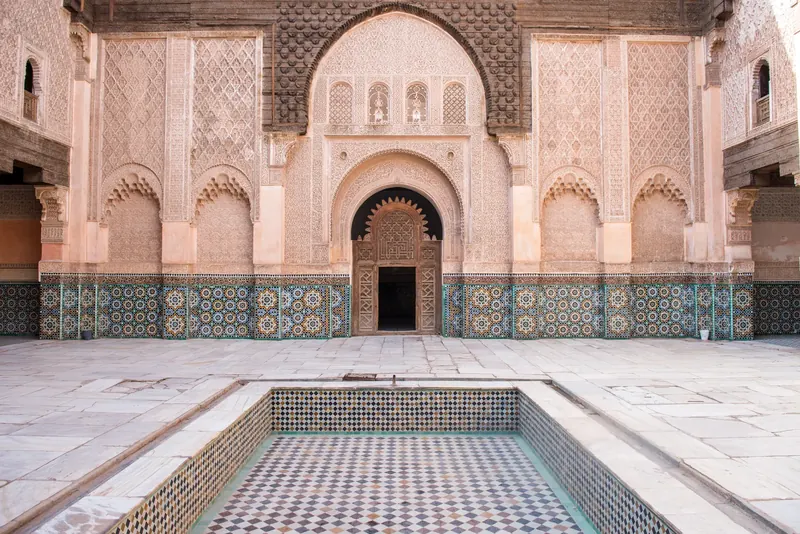
The site is more revealing when you notice how its parts differ. The Ministry describes a collection of courtyards, gardens, salons and annexes, with marble, moucharabieh screens, zellij tilework, stained glass, carved and painted wood, and stucco. 1 Rather than rushing from one photogenic courtyard to the next, compare how these materials meet: geometric tile paths frame open space; carved plaster and painted wood pull the eye upward; shaded galleries make the bright central courts feel more expansive.
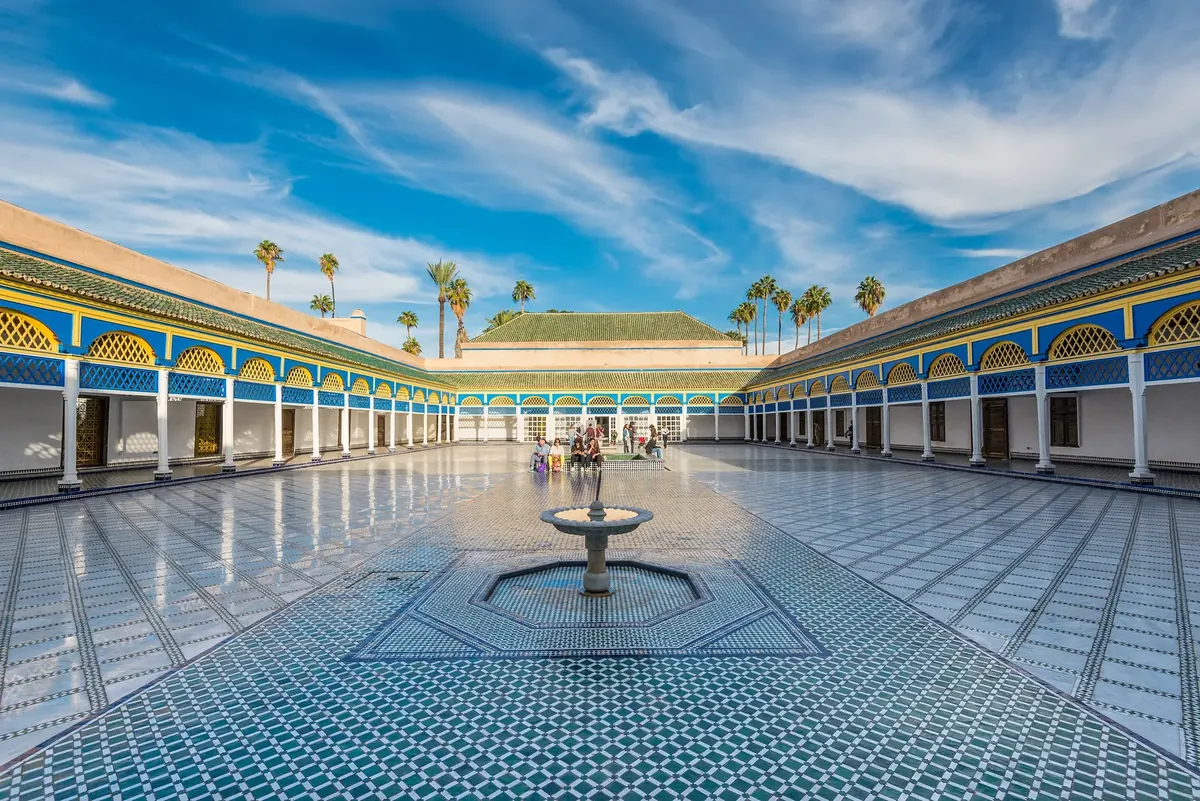
The palace grew in two main phases. Si Moussa developed an earlier residence in the second half of the 19th century; his son Ba Ahmed expanded it between 1894 and 1900. Because additions accumulated as land was acquired, the resulting plan is irregular rather than a single symmetrical axis. Archnet’s architectural record describes a large complex of walled gardens, pavilions and courtyard buildings, and identifies the marble-paved Cour d’Honneur as a major feature. 4 That layered plan explains why the visit feels like a sequence of thresholds and changing spaces instead of a formal march down one central corridor.
Give the large marble courtyard time, but do not treat it as the whole palace. Look for tilework dividing the floor, the fountain at the center, and the colored galleries around it. Then slow down in the smaller rooms: a ceiling or doorway can be the detail you remember most. The visit is also a chance to see crafts in context, not just isolated decorative motifs. Avoid leaning on fragile surfaces or stepping into closed rooms for a better photograph. Respect any signs or staff directions, especially where conservation and visitor access overlap.
How long to allow and when to go
As a planning estimate—not an official visit duration—reserve about 60–90 minutes for the palace itself if you like to examine architectural details and take photographs. A faster walk-through may take less; a crowded day, a slow photo pace or closures can alter that. Add separate time for reaching the entrance through the medina and for any queue. Do not schedule a timed onward booking immediately after the advertised closing time or assume the entire visit takes a fixed number of minutes.
If you can choose, arrive near opening rather than at the busiest middle of the day. This is a crowd-management suggestion, not a promise of quiet: tour groups may arrive early too, and the flow changes. If your schedule is fixed, accept that some courtyards may be busy and focus on looking up and stepping aside where space allows instead of waiting for a perfectly empty photograph. In hot weather, the courtyard route includes exposed spaces; bring water for the walk to and from the attraction and plan shaded pauses elsewhere in your day.
Getting there and building a medina day
Bahia Palace is inside the medina, so your final approach is on foot through busy lanes rather than a door-to-door vehicle drop at the entrance. Save the official map pin before leaving your accommodation and agree on a clear meeting point if traveling with others. Follow a map or a prearranged route rather than accepting unsolicited directions that turn into a paid guiding offer. If you do want a guide, agree on the scope and total price before starting.
The palace makes most sense as one stop in a southern-medina walk, not as the sole reason to cross town repeatedly. Nearby sights such as the Saadian Tombs or El Badi Palace can make a coherent history-and-architecture day, but check each site’s own hours, admission and access on the date—one ticket does not include another. For a first-time visitor still orienting themselves, our Marrakech city guide explains how the medina fits into the city. If you are comparing historic palace experiences, our Marrakech day-trip guide is not a substitute for checking local attraction details; keep your plan focused on the city if you have only a few hours.
A useful half-day plan is to visit Bahia Palace first, take a relaxed break nearby, then choose one additional monument or a medina stroll instead of stacking several interiors back-to-back. That leaves room for wayfinding, a ticket queue and a proper pause. Keep your route flexible if a space is closed or the courtyard is unusually crowded. For help coordinating a broader Morocco itinerary, see our Personal Travel Assistant service; admission tickets and any transport or guide remain separate purchases from their providers.
Accessibility, families and respectful photography
The official ticket page states free entry for individuals with reduced mobility, but that statement alone does not describe step-free routes, accessible toilets, surfaces or whether every section is reachable. Contact the palace in advance if these details affect your visit, and ask specifically about the entrance, courtyard transitions, seating and the areas open that day. The medina approach itself may involve uneven paving and crowded lanes, so include that in your accessibility decision. 1
For children, the courtyard sequence offers visual variety, but there are hard surfaces, fountains and spaces where adults need to keep children close. Use the official child-ticket category and age range rather than relying on third-party listings. If anyone in your group needs frequent rest stops, keep the visit short and choose one or two details to notice together rather than promising to cover every room.
Photography should never take priority over other visitors or restricted areas. Ask staff if a sign or rule is unclear, avoid blocking narrow passages, and do not use flash where it could disturb people or risk sensitive surfaces. Courtyards are naturally photogenic, but a clear view may require patience rather than pushing into a group.
Common planning mistakes
The most common avoidable errors are relying on stale prices, assuming online ticketing or skip-the-line products work exactly as advertised, and building an over-tight route around a fixed visit time. Confirm the ministry page and site status close to your visit. Remember that the complex is much larger than the public route, and access can change. Finally, Bahia and El Badi are different palaces with different histories and visitor experiences: choose the one that suits your interest, or leave enough time and budget to visit both independently.