What makes the madrasa worth a visit
Ben Youssef Madrasa is a former school and student residence, not a royal palace. Sultan Abdullah al-Ghalib of the Saadian dynasty commissioned the building in 1564–65, and it served as a center of learning for centuries. The official history describes study in religious disciplines as well as philosophy, medicine and mathematics. Its location in the old medina places it among the later architectural landmarks of a city whose historic core is recognized by UNESCO. 1 2
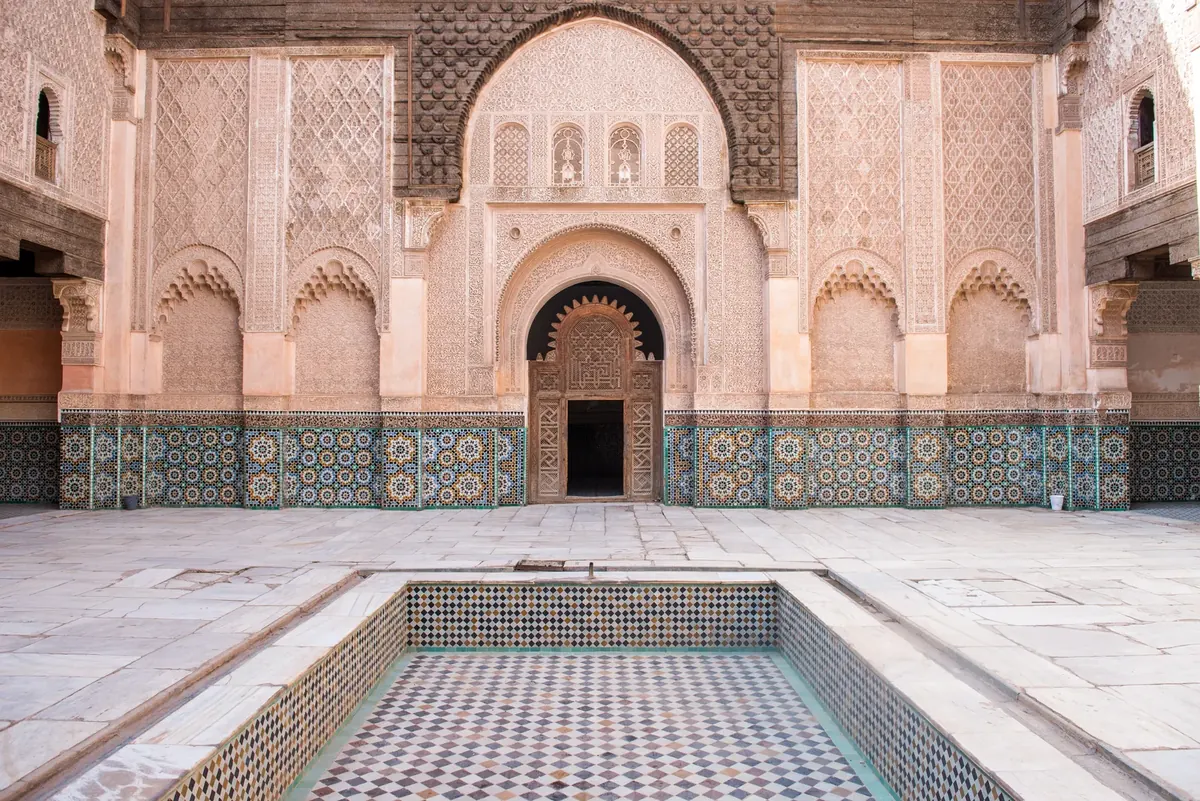
The building is rewarding because its parts tell a coherent story. Visitors move from the entrance into a central courtyard, where a shallow reflecting basin, carved cedar, geometric tilework and sculpted plaster draw the eye. Galleries lead toward modest chambers once used by students. The official site identifies carved wood, zellige and sculpted plaster as defining features. Look closely at transitions: how patterned tile gives way to carved plaster, and how the ornate shared spaces contrast with the plain, small rooms. 1
Tickets, hours and what to confirm
The official hours-and-tariffs page currently lists regular opening from 9 a.m. to 7 p.m. daily and 9 a.m. to 4:30 p.m. during Ramadan. It lists entry at 50 dirhams for foreign adults, 20 dirhams for Moroccan adults with identification, 10 dirhams for children under 12 and 30 dirhams for groups of 21 or more. Treat these as published information, not a guaranteed future rate: confirm before your visit, especially around Ramadan, holidays or any operational change. 3
There is a useful detail to check before you travel across town: the official homepage says its online ticketing system is under maintenance and that tickets are available only at the entrance. That status can change, so check the official site again rather than relying on an old booking link or assuming advance entry is possible. Carry a payment method that will work for an in-person purchase, and keep a small amount of cash available as a practical backup; do not assume a specific payment method is accepted unless the site confirms it. 1
The current official listing makes this a reasonably short cultural stop, but do not build your itinerary around an exact queue or visit duration. For planning, reserve about an hour inside, with extra time for walking to the entrance, ticket purchase and a pause to study the rooms. That is a suggested allowance, not a published rule. Earlier in the day can be a sensible choice if you prefer to explore before the medina feels busier; crowd levels are not guaranteed.
Finding it and fitting it into a medina walk
The official address is Assouel Street, Marrakech 40000, in the old medina. A map pin helps with the broad direction, but the last part of the route is through pedestrian-scale lanes. Ask your riad or driver for the nearest practical drop-off point if you are arriving by vehicle, then walk the remaining stretch using a phone map or clear directions. Avoid assuming that a car can reach the door. 3
For a first visit, combine the madrasa with nearby medina sights only if you have time to walk at an unhurried pace. This is a good anchor before or after browsing the souks, rather than a reason to cram a long checklist into one block. The medina is a lived-in historic district, not a museum precinct: keep an eye on map orientation, respect residents’ doorways and ask before photographing people. UNESCO describes the medina as a living historic town with lanes, houses, souks and traditional activities. 2
If you are already planning a wider Marrakech day, pair the madrasa with one or two other places rather than trying to cross the medina repeatedly. The city’s first-time visitor guide can help you decide which neighborhood and arrival plan suits the rest of your day: Marrakech travel guide. For more hands-on orientation through market lanes, see Marrakech souks guide.
How to explore the building
Start in the courtyard and take a moment before photographing it. The symmetry is easier to appreciate when you notice the doorways, upper-level galleries and visual axis across the basin. Then look at the materials in layers: tilework at lower levels, carved and painted wood overhead, and plaster carving around arches and frames. The decoration is not a collection of unrelated ornaments; it is a coordinated surface treatment across the architecture. 1
Continue into the smaller chambers and up to the galleries where access is open. These rooms are simple, and that simplicity is part of the point: the institution housed students, while its communal and devotional spaces carry much of the elaborate finish. Don’t assume every doorway or level is open; follow barriers and staff instructions, since access can vary during conservation or operations. The official site notes a restoration and rehabilitation project led by the Ministry of Habous and Islamic Affairs, underscoring that the building is maintained as heritage rather than a static set. 4
Give your eyes time to adjust between the bright courtyard and interior rooms. If photography is a priority, take wide views first, then details of woodwork and tile; be considerate when other visitors are framing the same courtyard. Tripods, flash or commercial photography rules can change, so ask staff rather than assuming. The historic surfaces are the attraction—do not touch carved work or lean on fragile edges.
Practicalities: stairs, children and comfort
The route includes historic thresholds and stair access to upper areas. This makes a fully step-free visit unlikely, but published information does not specify a definitive accessible route or current facilities. If you use a wheelchair, have limited stamina or need to avoid stairs, contact the site in advance and ask exactly which areas are accessible on your date. Do not rely on broad assumptions based on photographs. The courtyard alone may still be visually worthwhile, but confirm entry and route conditions before making the trip.
With children, set expectations that this is a historic building, not an interactive museum. Agree to stay together in narrow passages, take care on stairs and give children a simple detail-hunt—such as finding repeating geometric patterns—rather than encouraging touching or running. Strollers may be awkward on stairs and uneven surfaces; a carrier may be easier for a young child, depending on your family’s needs.
Wear comfortable walking shoes and bring water for the walk through the medina; follow any posted rules about food and drink inside. The official site’s hours and ticketing status are the most useful items to recheck immediately before you go. If you would like help coordinating a route or practical arrangements during a Morocco trip, the Personal Travel Assistant service is described at /services; the madrasa itself remains an independently operated attraction, and any entry is paid to the site.
Is it right for your itinerary?
Choose the madrasa if you enjoy historic architecture, decorative craft and learning how a building was used. It is especially satisfying for visitors who are willing to look beyond a single courtyard photograph and compare formal communal spaces with the small student quarters. UNESCO includes the Ben Youssef Madrasa among the later architectural treasures of the Medina of Marrakesh, while the site’s own account supplies the building’s Saadian-era date and educational role. 1 2
If you have only a few hours in Marrakech and prefer gardens, contemporary art or broad outdoor spaces, compare it with your other priorities rather than treating every famous monument as compulsory. The madrasa is a focused indoor heritage visit that fits naturally into a medina walk. Allow time for the approach, check ticket conditions and go with curiosity about the details; that is more useful than planning around a perfect empty-courtyard photograph.