What the Marrakech souks are—and how to approach them
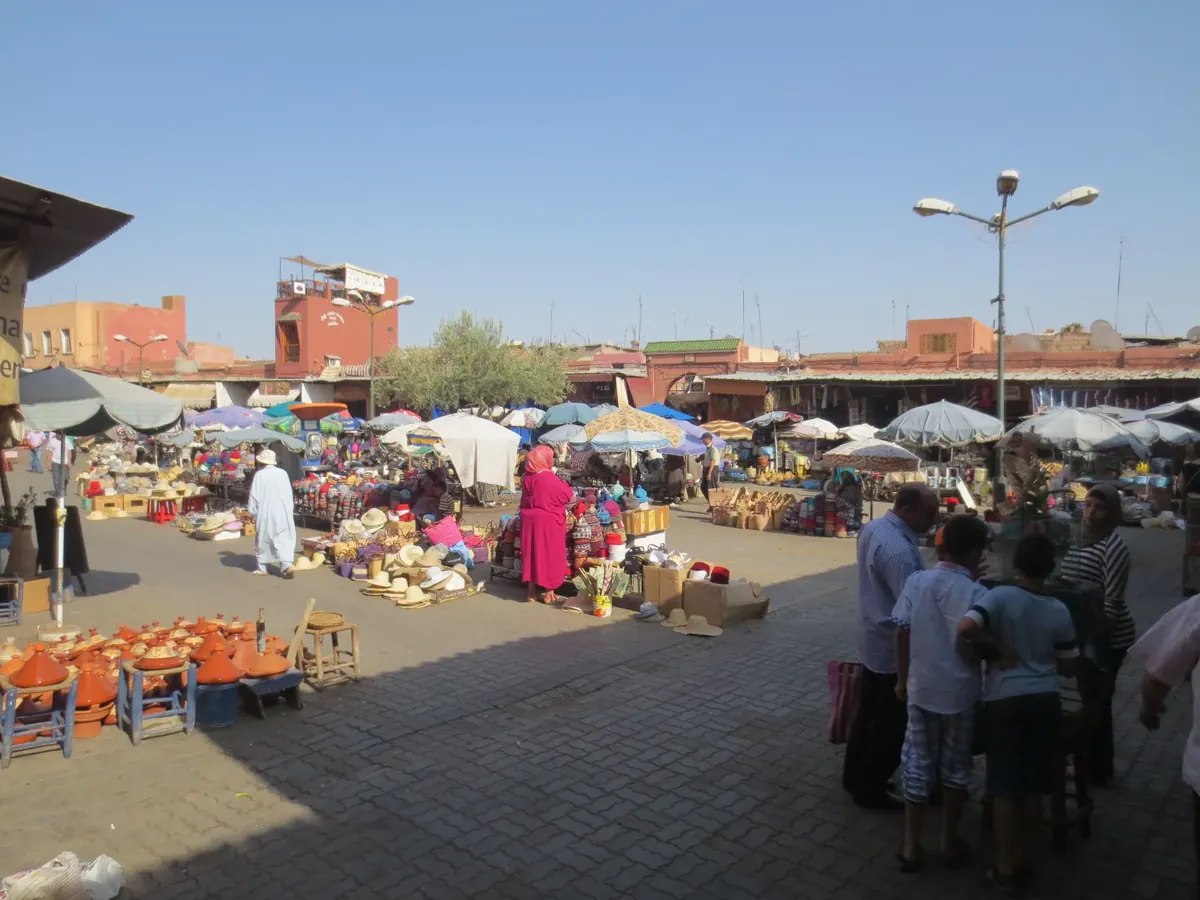
The Marrakech souks are a dense network of market streets in the historic medina, rather than a single enclosed bazaar with one entrance. Their lanes extend from the area around Jemaa el-Fna, and some retain clusters associated with particular crafts. The national tourism office presents strolling the souks as part of the city’s medina experience, while also distinguishing the newer shopping districts of Guéliz and Hivernage.1
That means a good visit is less about ticking off every named market and more about choosing a few things you actually want to see. Begin around Jemaa el-Fna, walk into the market streets, and let the experience be a mix of browsing, watching craftwork and shopping. If you have a specific purchase in mind, keep enough time to compare several examples before deciding.
A useful first outing is simple: orient yourself near the square, browse without buying for a while, stop for a drink or a rest when you need one, then return to a shop you liked. Keep an offline map available and notice the route back to a recognizable landmark. Lanes can feel similar, and the market is part of an active city rather than a pedestrian-only attraction.
Which souks and crafts should you look for?
Names and boundaries in the medina are not always obvious to visitors, and shops can sell overlapping goods. Still, familiar names can help you set a loose direction. Souk Semmarine is commonly described as a major shopping artery with a broad mix of wares; Souk Smata is associated with babouches (slippers), while Souk Haddadine is known for metalworkers and lanterns. Rahba Kedima is an open square often associated with spice and basket sellers.2 Treat these as orientation cues, not guarantees that every shop in an area sells only one thing.
For leather goods, look closely at the seams, lining, fastenings and smell, and ask what material the item is made from. For slippers, try them on if possible and check whether the sole and fit suit how you plan to use them. For lanterns and copper or brass objects, inspect joins, weight and finish; decorative appearance alone does not establish how an object was made. The Moroccan tourism office describes leather as an important Marrakech craft and notes metalwork traditions, but that does not verify the provenance of a specific product in an individual shop.3
Rugs require a slower decision. Ask about fiber, dimensions, construction, cleaning and whether the pattern or colors have a regional or maker-specific story. Ask the seller to show the reverse and edges, and compare pieces rather than choosing under pressure. The tourism office describes Moroccan carpets as regionally varied and notes that many are traditionally handmade, but an individual carpet’s material and production method still need to be confirmed with its seller.3
Spices, soaps and small accessories are easier to pack, but still check packaging, ingredients and whether the product can be taken through your planned transport and customs rules. If you are buying for someone else, photograph labels or note the product name and seller’s description before leaving.
How to bargain without making it awkward
In shops where the seller invites negotiation, bargaining is a conversation, not a test of whether you can extract the lowest possible price. Begin by asking the price and giving yourself time to consider. If you want the item, make a counteroffer that feels reasonable to you, then listen to the response. Smile, stay courteous and avoid turning a small difference into a confrontation. If the price does not work for you, say thank you and leave; you are not obliged to buy because you asked questions, accepted tea or spent time looking.
There is no dependable rule such as “offer half” that works for every product or shop. A price depends on the item, materials, workmanship, seller and whether it is a fixed-price setting. Instead, use a practical sequence: compare similar objects at a few stalls; decide your own maximum before negotiating; make one clear offer; and pause rather than raising your bid just because the seller counters. If you are shopping for several items, ask whether there is a combined price, but confirm each item and the overall total.
For example, if a seller quotes 600 dirhams for a lamp, you might first inspect its size and finish, then decide that your personal limit is 400. You can offer 350 and see whether the seller proposes a middle figure; those numbers are only an illustration of the arithmetic, not a guide to current Marrakech prices or a claim that the lamp should sell for any particular amount. Accept only if the final amount feels fair to you.
Some stalls display prices or operate more like conventional retail. Ask, “Is this the final price?” before assuming bargaining is expected. If you have a firm budget, it is fine to say so politely. Do not feel that you have to buy something to prove you are a good traveler, or that you need to bargain aggressively to shop well.
Quality, payment and getting purchases home
Before paying, repeat the agreed total and currency, especially if you have negotiated more than one item. Check that the item you are taking is the one you inspected, and ask about packaging, delivery, shipping fees, timing and what happens if a shipped item arrives damaged. Morocco’s Ministry of Industry and Trade lists clear information on prices, labeling and conditions of sale among the aims of its consumer-protection law, and says consumers should receive necessary information before concluding a sales contract; these practical checks help you clarify the terms of your own purchase.4 Get the terms in writing when a purchase is valuable or being sent abroad. Do not assume shipping, customs charges or returns are included unless the seller has explicitly confirmed them.
For a large rug, ceramic piece or lamp, consider whether it will fit your luggage and whether you can carry it safely through the rest of your itinerary. Ask for the packed dimensions and weight. If a seller offers to arrange shipping, compare the complete cost and delivery details before agreeing. The seller’s assurances are not a substitute for checking current US import requirements for the particular product, especially where natural materials or protected species could be involved.
Keep cash and payment cards secure, and count change discreetly. If paying by card, confirm the amount shown on the terminal before approving it. If you are unsure about quality or price, take a photo of the item (ask first if photographing is appropriate), step away and think. A short pause often makes a better souvenir than an impulsive purchase.
Practical comfort and respectful browsing
The market lanes are working streets. Walk to one side when stopping to examine goods, and pay attention to bicycles, motorbikes and handcarts moving through narrow passages. Keep bags close in crowded places as a general city-travel precaution. If a person offers unsolicited directions or an escort, you can politely decline and continue toward a shop, café or known landmark; do not accept a service you do not want merely because you are uncertain where you are.
Ask before photographing a person or a work area. A shopkeeper may welcome a conversation about an object, but do not handle delicate goods without permission. If you are traveling with children, agree a meeting point and keep them close in busy lanes. Travelers with mobility needs should plan for uneven surfaces, narrow passages and congestion; the souks are not uniformly accessible, and a shorter out-and-back visit may be more comfortable than a long wandering route.
You can make the visit worthwhile even without buying anything. Take time to notice how goods are displayed and how different materials are worked. If you want support coordinating independent travel arrangements around Marrakech, Maroc Mobility’s Personal Travel Assistant is separate from shopping; goods and experiences are provided and charged by their own providers.