Choose the route before comparing vehicles
Most Marrakech-to-Fez choices begin with one question: are you moving between two cities, or do you want the journey to become part of the itinerary? If you simply need to arrive ready to explore Fez, start with rail. If the road is the experience—because you need a particular stop, have a group to move, or are intentionally building a multi-day route—then a vehicle can be the better fit. A flight is useful only when its actual dated itinerary beats the complete ground journey at both ends.
| Option | Choose it when | Do not choose it just because |
|---|---|---|
| Train | Your date has a sensible ONCF itinerary, you want one booked city-to-city move, and you can manage the station-to-accommodation handoff. | A generic journey time looks shorter than driving. Your hotel, bags and arrival time still matter. |
| Flight | A booked, usable nonstop is available and both airport transfers fit your day. | The airborne segment is short. That is only one part of the journey. |
| Private road transfer | You genuinely need door-to-door service, a defined stop, child-seat confirmation, or one vehicle for your party and luggage. | You assume a car automatically makes the route faster or more flexible than rail. |
| Self-drive | You want to control a deliberate road itinerary and have checked your own licence, rental and cover terms. | You only need a direct city move and have no use for the car after arrival. |
| Coach | The operator’s live search offers a suitable journey and the budget trade-off is worth the extra station handoffs. | A dated blog post says a particular service still runs. |
This is the route-specific decision missing from a general Morocco train guide: a rail trip, a flight and a road itinerary can all reach Fez, but they solve different problems.
The fastest practical choice: a dated itinerary test
Run this test before you buy a non-refundable ticket or accept a road quote. It prevents the common mistake of comparing an operator’s headline duration with a vehicle that collects you at your door.
- Write your real start and end points: your Marrakech accommodation or airport, and your Fez hotel, riad meeting point or apartment.
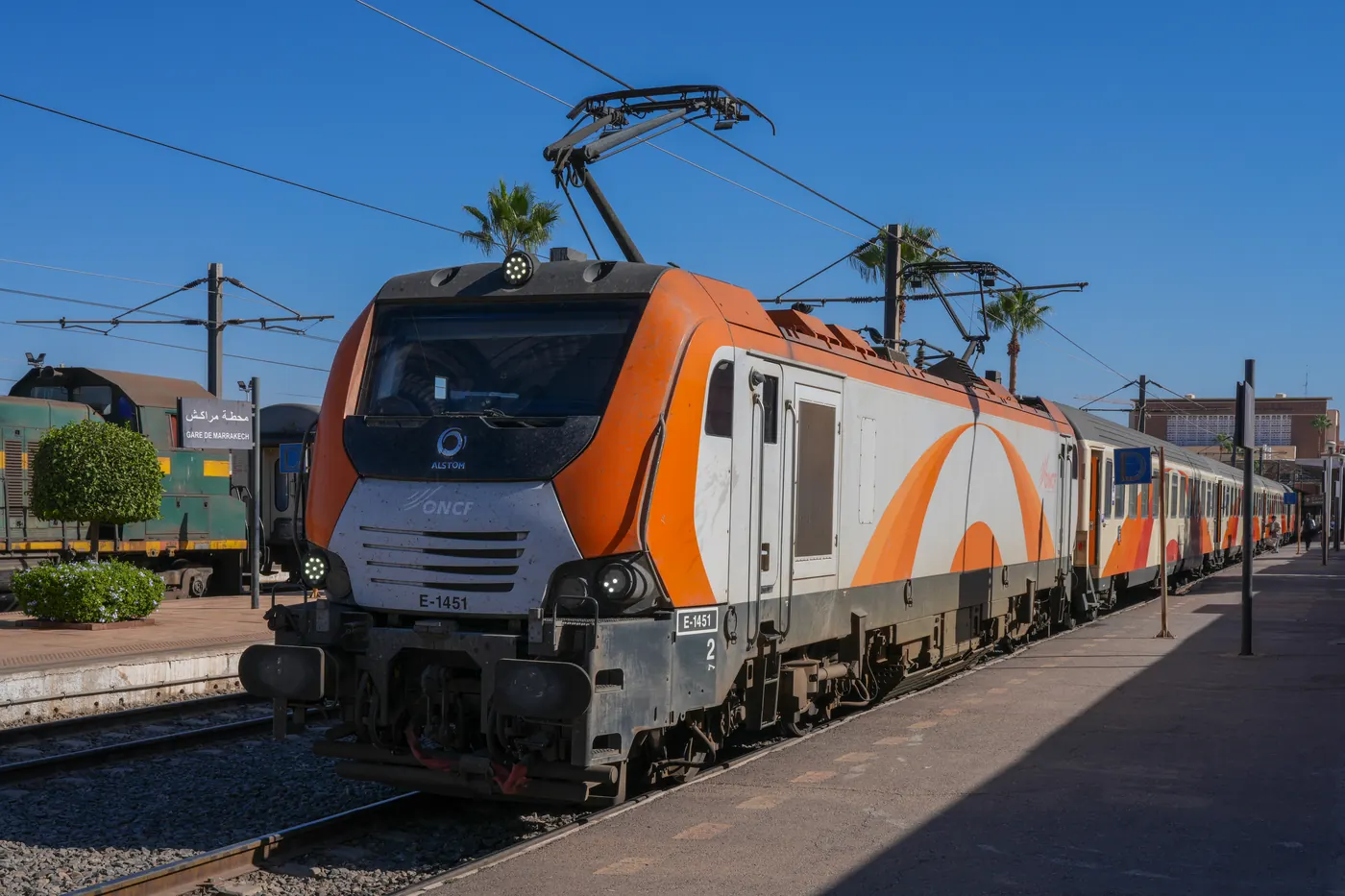
- Search the exact date in ONCF’s official journey planner. Record the displayed stations, departure and arrival, any connection, and the fare conditions before payment. ONCF’s live timetable is the reference for the train decision, not an old screenshot or a third-party estimate. 1
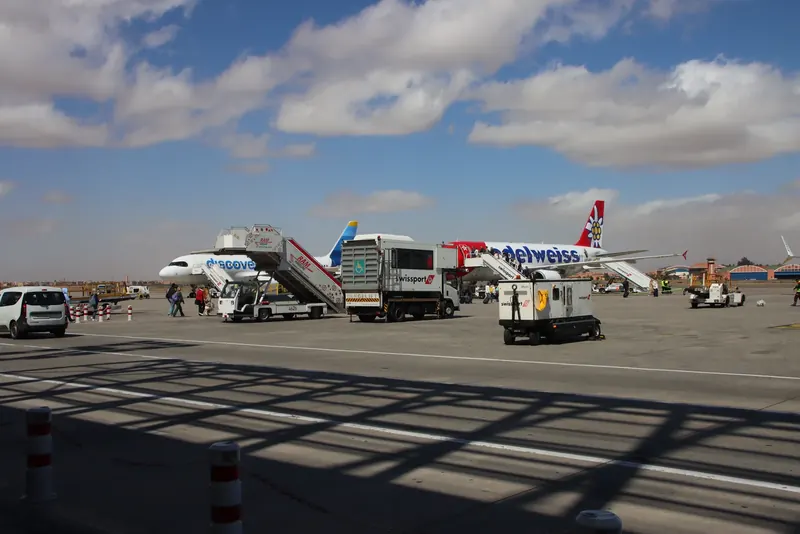
- If considering air, search the same date and record whether the itinerary is actually nonstop, which airports it uses, baggage terms, and the transfers before and after the flight. Royal Air Maroc lists both cities in its domestic network, but that does not promise a direct service on your date. 3
- For a vehicle, ask for a written quote to the actual drop-off point. A riad inside or near a medina may require a nearby meeting point rather than a curbside arrival.
- Compare the first time you can realistically check in or begin your Fez plans—not just train departure, take-off or car collection.
A coach can be a useful fallback when the dated schedule and station locations work for you. CTM directs travellers to an online booking search for current services and fares; treat that live result as the answer for your date rather than assuming a fixed frequency. 2
When the train is the better direct move
Take the train when the official planner produces an itinerary you can live with and your priority is a contained city-to-city travel day. It is usually the cleanest choice for travellers who do not need countryside stops, do not want to navigate a rental pickup and return, and can arrange the short onward leg at each station.
Before paying, check these items in the displayed itinerary:
- the exact station names and whether a change is shown;
- the ticket’s displayed conditions, rather than assuming it can be changed later;
- the departure time against your Marrakech checkout or airport arrival;
- the plan for bags, valuables and the final transfer in Fez; and
- whether a late arrival would make your accommodation handoff awkward.
Fès station is an arrival point, not automatically the door of a medina stay. Put the host’s meeting point or a licensed local transfer into the plan before you board, particularly if you will have luggage. For broader rail booking and station guidance, see routes, tickets and private-transfer decisions in Morocco.
When flying actually saves time
A plane can be the right answer when a specific, nonstop itinerary has useful departure and arrival times and you can make the two airport transfers without turning the day into a chain of waits. It is not enough that a route map includes both cities; the carrier’s network is not a guarantee of a direct flight, seat, fare or connection on every date. 3
Use a flight only after you can answer all four questions:
- Is the booked itinerary nonstop, rather than a connection through another city?
- Can you reach Marrakech Menara Airport from where you are staying with enough margin for the airline’s current requirements?
- Do your booked fare and bags fit what you will carry?
- How will you travel from Fès–Saïss Airport to the exact place you are staying?
If one answer is uncertain, compare it again with the train rather than relying on flight time alone. The separate Marrakech airport arrival and departure guide can help with the Marrakech-side handoff.
Road transfer or self-drive: use it only for a purpose
A private road transfer is not the same purchase as a rental car. With a transfer, a provider supplies the vehicle and driver under its own terms. With self-drive, you are responsible for meeting the rental provider’s documentation, age, experience, payment, deposit and coverage rules, as well as for the drive. Those terms are supplier policies, not one universal Morocco rule.
For UK licence holders, the Foreign, Commonwealth & Development Office says to carry both a UK driving licence and a 1968 International Driving Permit in Morocco; it also notes that hire companies may require driving experience and a higher minimum age. This is UK-specific guidance, so it should not be treated as a rule for every nationality. 4 Check the authority that issued your licence and the rental company’s written terms before reserving.
Also separate protection products correctly: a rental contract’s damage waiver and excess are contractual terms, while travel insurance, credit-card cover or other insurance may have separate eligibility and exclusions. Ask what is included, what the excess is, and what documents a claim would need; do not assume one replaces the other. The Morocco car-rental guide and driving guide explain the wider questions to settle before choosing self-drive.
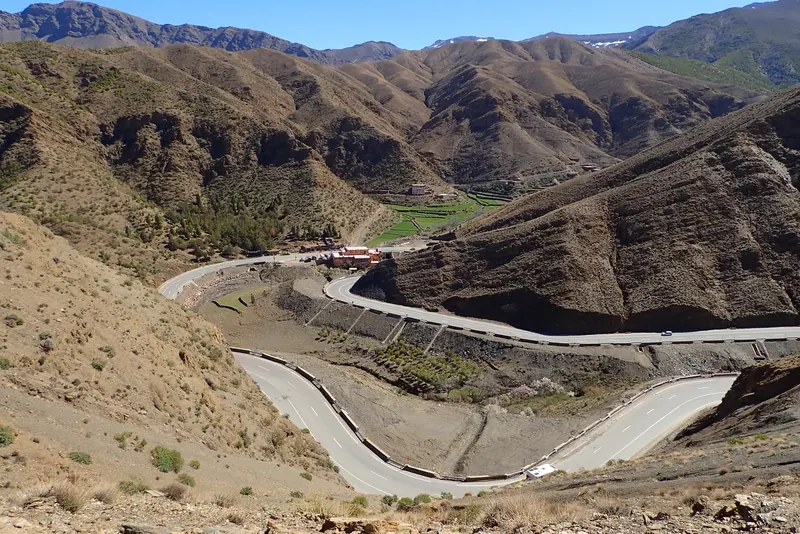
For either self-drive or a road transfer, use daylight planning and a weather check for the route. UK travel advice warns that poor lighting can make night driving dangerous and that poor weather can make secondary and mountain roads especially hazardous. 4 That is a reason to build a conservative arrival plan, not a promise that any particular road will be open or trouble-free.
Make an overnight stop intentional
There are two honest reasons to add an overnight between Marrakech and Fez.
A break overnight has a narrow job: split a road journey so you are not trying to arrive tired or after dark. Choose it for a safe, confirmed place to sleep and continue; do not overload the day with attractions that create a new rush.
A route-led extension has a different job: you deliberately want the south, desert edge or mountain scenery to be part of the Morocco trip. That needs its own sequence, accommodation and transfer choices. It is not a quick stop on a direct city transfer. If that is your aim, compare the Marrakech-to-Merzouga travel choices and the longer first-time Morocco itinerary before committing to a one-way car or driver.
Avoid booking an overnight simply because another traveller’s road time sounded manageable. Start from your own check-out time, expected breaks, seasonal daylight, weather and desired Fez arrival. The right overnight is the one that makes the next day simpler, not one that adds another forced sightseeing schedule.
Build a door-to-door plan before you book
Use this mini checklist for each option you are still considering:
- Origin: exact Marrakech pickup point, with your latest realistic departure from the accommodation.
- Main leg: operator, booked itinerary or written road quote, plus its change or cancellation terms.
- Bags: who carries them during station, airport or medina handoffs, and whether the vehicle capacity is confirmed.
- Arrival: exact Fez station, airport or roadside drop-off; host contact; and a meeting point that a vehicle can actually reach.
- Fallback: what you will do if a service changes, baggage is delayed or the arrival is too late for the planned handoff.
A train stopped at Fès railway station is still only the main leg. Plan the separate transfer or walk to your accommodation, then leave room to recover before starting your Fez sightseeing plan.
What to confirm with a road-transfer provider
Request a written answer to these points before treating two quotes as comparable:
- the exact pickup and drop-off points, including any medina meeting point;
- total price, currency, and whether tolls, fuel, parking, waiting and planned stops are included;
- vehicle type, passenger count and luggage capacity;
- child-seat, mobility or other specific needs;
- whether stops are included, how long they may be, and whether attraction entries or local guides are extra;
- cancellation, change, delay and payment terms; and
- an operational contact for the day of travel.
A cheap-looking quote that leaves these items open is not yet comparable with a rail or air ticket. If you want help making the handoffs clear while independent providers retain their own bills and terms, see Maroc Mobility’s Personal Travel Assistant service.