Decide whether to cross today
The sensible plan is a full daylight road day with a go/no-go check, not a promise based on a navigation estimate. The U.S. Department of State describes roads through the Atlas as steep, narrow and winding, and notes that rural flash flooding can occur during the November–March rainy season. The UK Foreign, Commonwealth & Development Office also flags poor-weather mountain roads and night driving as particular risks. Morocco’s Ministry of Equipment and Water publishes road-state information and possible diversions for the national network. 1 2 3
That does not mean the route is always unsuitable for self-driving. It means the decision belongs to the day you travel. Cross only if you can answer yes to all four questions: the official information does not indicate a restriction on your route; the forecast and visibility are acceptable for your experience; the car and contract are suitable for the planned paved route; and you can reach your confirmed Ouarzazate stop before dark without rushing. A “no” or an uncertain answer is a reason to postpone, reorder the nights or use a separately confirmed transport option.
For the wider choice of rental car versus other transport, start with the Morocco road-trip planning guide. This page is about executing one mountain crossing, not choosing an entire countrywide itinerary.
Keep road rules, rental terms and cover separate
Driving law is not rental approval. The U.S. Department of State says foreign driving licences are valid for use in Morocco for up to one year; after that, foreign residents need a Moroccan licence. That is a temporary-driving rule, not a promise that a rental counter will accept every licence or payment method. 1
Nationality matters. For UK licence holders, the FCDO says to carry both the UK licence and a 1968 International Driving Permit; it says Morocco no longer accepts the 1949 IDP. Travellers using another country’s licence should not assume that UK-specific instruction applies to them. Check their own government or consular guidance and ask the chosen supplier what it needs in writing. 2
Rental eligibility is supplier policy. The FCDO notes that hire firms can set stricter conditions, including a required driving-history period and a higher minimum age. Before paying, have the named supplier confirm the primary and additional drivers, minimum age, licence tenure, cardholder, deposit/hold, roadside-assistance contact, permitted roads and what happens if the planned route closes. Those terms can differ even where driving is lawful. 2
A waiver is not a weather clearance. Read the agreement separately for included insurance, the damage-waiver excess, exclusions and any card hold. Those are contractual financial terms; they do not make a closed, flooded or low-visibility road appropriate to drive. See Morocco car-rental insurance, deposits and card holds for the questions to put in writing.
Plan the crossing day, not just the route
Make arrival before dark the fixed constraint. The rest of the day should flex around it. Do not use a slow truck, an extended stop or a changing forecast as a reason to hurry through bends or overtake without a clear view. The official warnings about limited lighting, other road users and mountain weather are why this margin matters. 1 2
| Part of the day | Plan for | If it takes longer than expected |
|---|---|---|
| Before leaving Marrakech | Road-status check, forecast, fuel, offline navigation, rental documents and a daylight arrival target | Drop optional stops or postpone the crossing; do not create a late departure to preserve a sightseeing plan. |
| Climb, pass and descent | A small number of legal, safe pull-offs for the driver to rest and for passengers to take photos | Remove the next optional stop. Keep the driving pace steady rather than trying to recover time. |
| Arrival area | Check-in, parking and an evening that does not depend on more rural driving | Go directly to the confirmed lodging. Move any Ouarzazate sightseeing to the next day. |
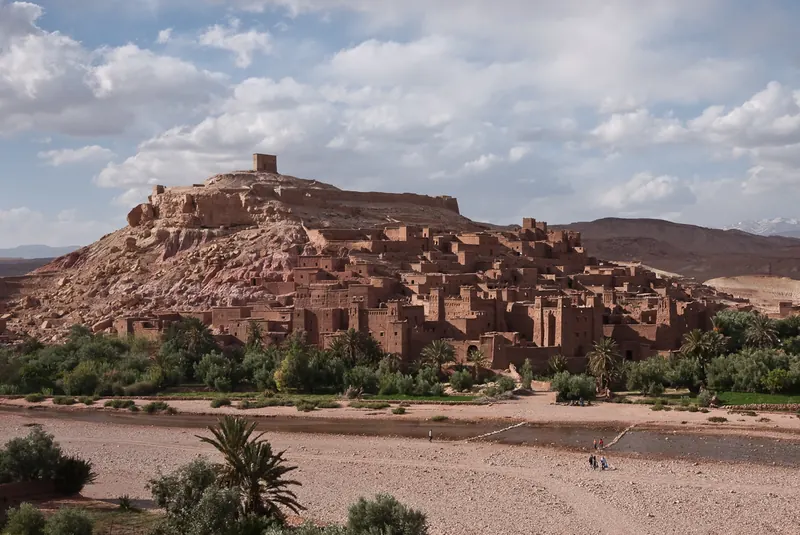
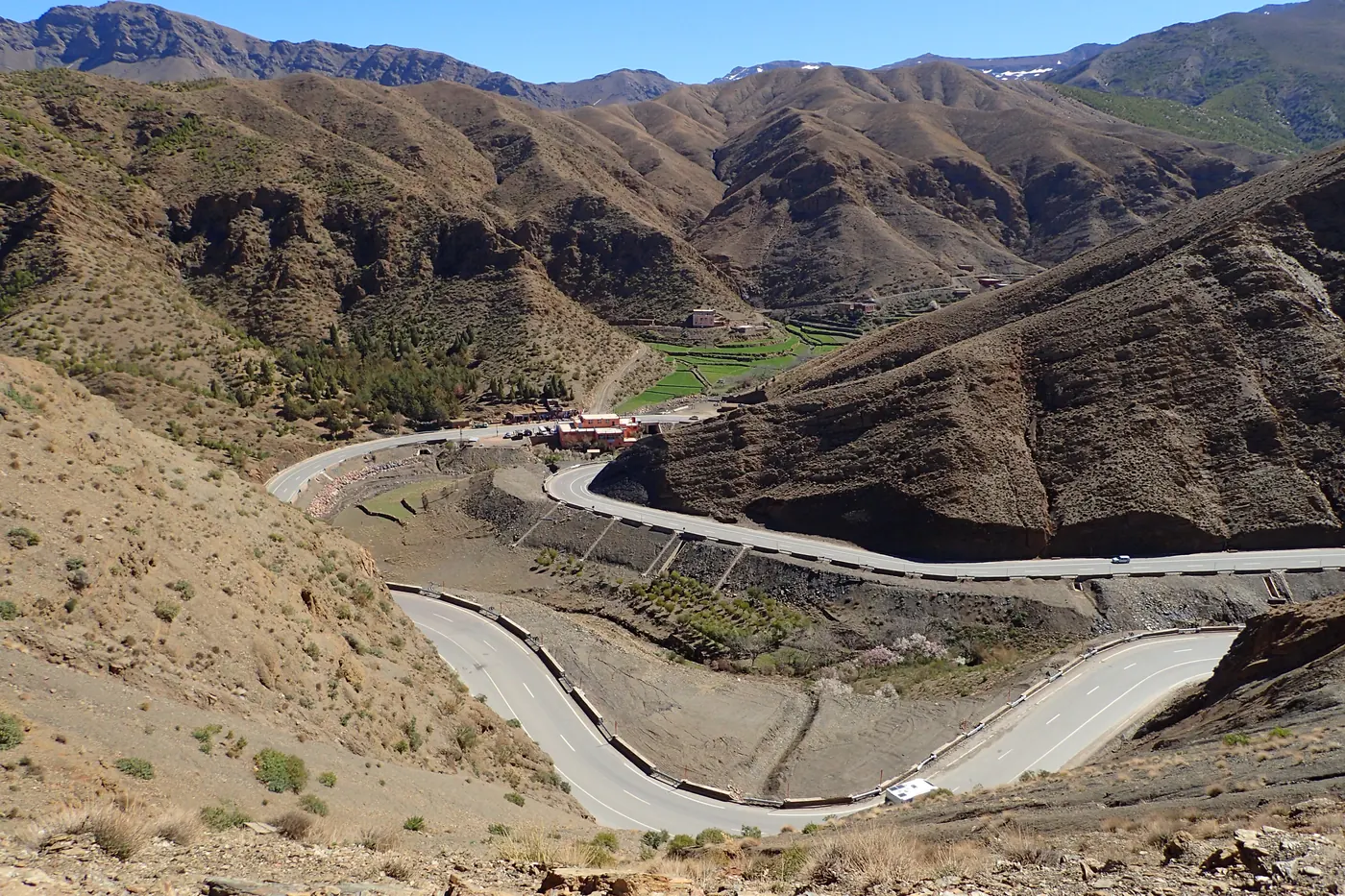
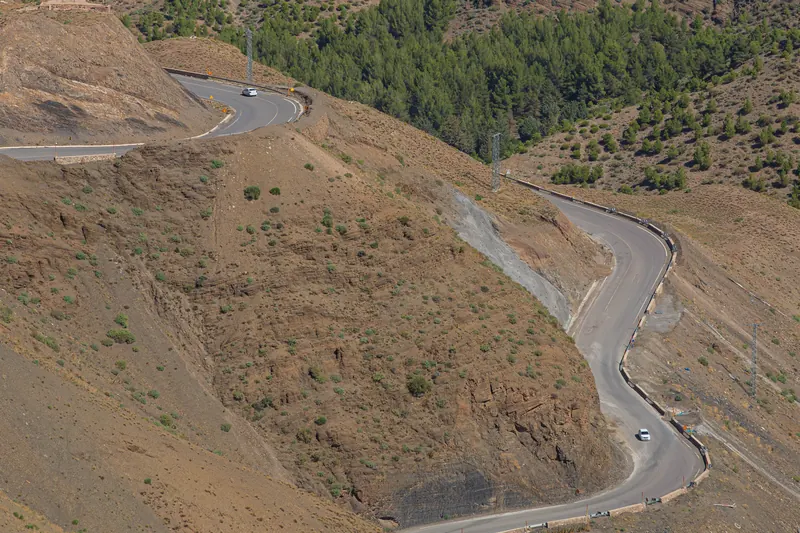
A photograph from 2018 can show why corners and elevation call for margin, but it cannot tell you today’s surface, traffic or weather. Use current official information for those. A scenic diversion toward Telouet, the Ounila Valley or Aït Benhaddou is a separate commitment, not an automatic “quick stop” on a crossing day. If that is the priority, use the dedicated Ounila Valley self-drive plan and build the extra time around it.
Make a day-of go/no-go check
Check the Ministry of Equipment and Water’s road-viability information on the morning of travel. Its road service says it issues periodic public bulletins, runs a 24/7 information centre and provides the Maroute mobile map; the stated purpose includes informing drivers about conditions, closures and possible diversions caused by snow, floods, rockfall or landslides. 3
Use that official check alongside a current forecast for the mountain section, not a social-media post from a previous storm. Then ask the rental supplier one operational question: if the N9 cannot be used today, what assistance and route restrictions apply to this specific booking? Keep the reply with the contract.
Turn back or do not start if an authority has closed or restricted the road, visibility is materially worse than the driver can manage, a warning has removed the daylight margin, or the driver is already tired. This is a route decision, not a test of vehicle type. A larger vehicle, a four-wheel-drive badge or a damage waiver does not override an official restriction or a supplier’s road-use terms.
For winter-specific buffers and wet-weather decisions, read winter driving in Morocco: Atlas rain, snow and route fallbacks.
Use a real fallback, not an improvised detour
If the crossing is not suitable, the safest fallback is usually an itinerary change: stay where you are, move the Ouarzazate night if its terms allow, or take a separately confirmed transport or driver option on another day. Do not assume that another line on a map is an equivalent detour, that an unpaved track is covered by a rental agreement, or that a route used by others is open to you.
Tell the accommodation and any onward provider early that the mountain crossing is delayed. That preserves choices without turning the final hours of daylight into a race. Once you arrive, use the Ouarzazate travel guide to choose a realistic next-day plan, or the Aït Benhaddou visit guide if the ksar is your next stop.
Before you turn the key
- Carry the original licence and, where required for your nationality, the correct IDP; keep the rental agreement, vehicle documents and insurer/roadside-assistance contact accessible. 1 2
- Photograph the vehicle condition at collection and confirm the fuel policy, tyre/spare or repair process, and the procedure for a breakdown or road closure.
- Download the route for offline use, but regard it as navigation—not proof that the road is open.
- Pack water, a warm layer and charged phones; mountain conditions and delays can differ from Marrakech and Ouarzazate.
- Set the first decision point before departure: if the official road information or weather does not support a calm daylight crossing, use the fallback.
If you want help coordinating a Morocco itinerary around separate providers and their written terms, see the Personal Travel Assistant.