What you can see at Koutoubia Mosque
The realistic visitor experience is an exterior visit. Koutoubia is an active mosque, and its prayer spaces are not a general tourist attraction; visitors who are not Muslim should plan to view the complex from outside rather than expect entry to the prayer hall. The local tourism listing describes it as a double sanctuary, while MoroccoMuseum’s site information likewise distinguishes the exterior and gardens from the Muslim-only interior 1 2. There is no reason to buy an interior ticket or book a prayer-space tour for this visit.
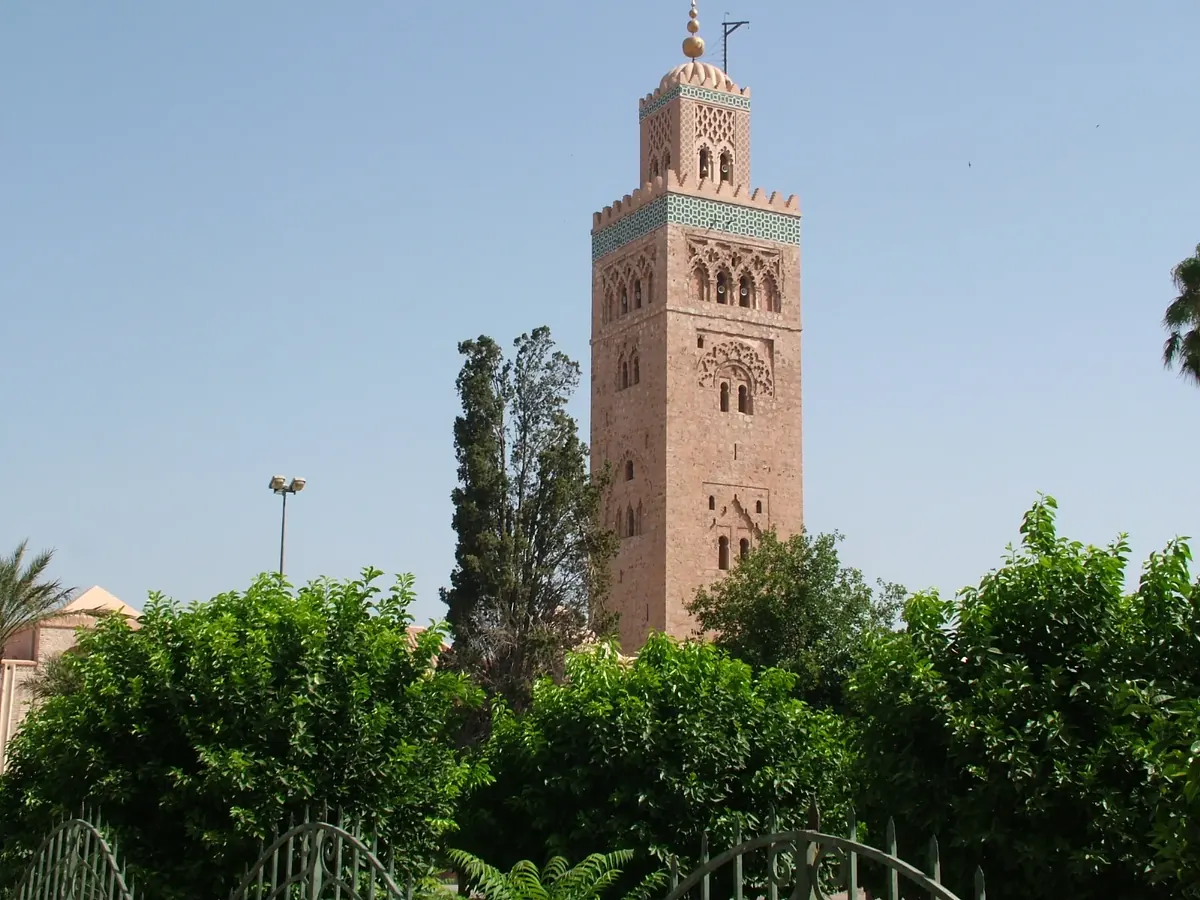
The main sight is the minaret, a 77-metre Almohad tower that rises above the surrounding medina. UNESCO identifies it as a defining landmark of Marrakesh’s historic urban landscape 3. Take time to look at the tower’s square proportions and the decorative bands near its upper sections, then notice how it appears from different angles rather than taking one quick photograph and leaving. The adjoining mosque is much larger than the visible tower suggests, but most visitors cannot inspect its interior.
The mosque belongs to the living historic fabric of Marrakech, not a museum display. The Medina of Marrakesh is a UNESCO World Heritage property whose identity includes monuments, gardens, lanes and the still-used historic urban environment 3. That context is useful: the call to prayer, worshippers coming and going, and the nearby city bustle are part of a functioning neighborhood. Observe quietly, avoid blocking entrances, and do not photograph people in a way that intrudes on their worship.
Where it is and how to orient your visit
Koutoubia sits immediately west of Jemaa el-Fna at the edge of the medina. The official Marrakech tourism listing gives its address on Rue Ibn Khaldoun; a local visitor listing places it roughly 300 metres west of the square 1 4. In practical terms, use the minaret as a visual reference when approaching from the square, but check a map for the specific public path you want: walls, traffic and pedestrian crossings mean the apparent straight-line distance is not always the easiest route.
The surrounding garden paths and public exterior viewpoints are where a visitor’s time is spent. MoroccoMuseum describes exterior garden access as free and throughout the day, while also noting that opening details can vary with cultural programming 2. Treat that as useful orientation, not a promise that every gate or path will be open during every visit. If the garden is closed or partly restricted, the minaret and mosque can still be appreciated from streets and open public viewpoints nearby. No ticketed Koutoubia attraction is needed for an exterior look.
A practical approach is to arrive from Jemaa el-Fna, take a slow circuit along the accessible outer paths, pause to look up at the tower and its patterned surfaces, then continue toward the souks or back to the square. Allow enough time for a gentle stroll and photographs, but do not build a tightly timed plan around a posted duration from a third-party listing. Crowds, heat, prayer activity or temporary access restrictions can change the pace.
Choosing the best time and viewpoint
Late afternoon often gives the sandstone-colored minaret warmer light; morning is a sensible choice if you prefer a less busy walk. MoroccoMuseum’s visitor guidance highlights both the quieter morning atmosphere and late-day light, but these are viewing preferences rather than guaranteed conditions 5. Weather, dust, seasonal daylight and crowd levels affect the result. If photography matters, take a few minutes to move around the perimeter and see which direction gives you a clear tower silhouette without putting people or restricted areas in the frame.
The minaret is also useful from farther away. Because UNESCO notes its prominence in the cityscape, it can help orient a walk through the old city 3. But it is not a substitute for street-level navigation: narrow medina lanes bend, and a landmark that appears close may be separated from you by walls or an indirect route. Save the destination pin offline or ask your accommodation to mark the easiest approach if you are unfamiliar with the area.
What to wear and how to behave
For the exterior, visitors do not need to dress as if entering a prayer hall, but modest, comfortable clothing is a considerate choice around an active religious site. Covering shoulders and knees is a simple, respectful option, particularly if your walk also includes other sacred or historic spaces. Wear shoes suited to uneven paving and standing in the sun. The gardens are not a guaranteed shaded refuge, so carry water in warm weather and take breaks as needed.
Keep voices low near worshippers and leave clear space at entrances. Do not walk through barriers or follow people into areas that appear reserved for prayer. Ask before photographing an individual, especially during prayer. Families can make this an easy short stop: explain beforehand that the mosque is a place of worship and that the visit is about seeing the exterior, not going inside. Strollers may be less convenient where paths or crossings are uneven; use the street-side viewpoints if moving through garden paths is difficult.
Fit it into a Marrakech day
Koutoubia works best as one piece of a walk, not a half-day destination on its own. Pair it with Jemaa el-Fna and the souks if you want a compact medina outing, or use it as a pause before continuing to another historic site. For a broader introduction to neighborhoods and getting around, see our Marrakech first-time visitor guide; for market etiquette and navigation, use the Marrakech souks guide.
If you want historical interpretation, arrange a reputable local guide for a wider medina walk and confirm exactly what is included; a guide does not change access to the mosque’s prayer areas. Check the day’s local conditions before setting out rather than relying on old pages for fixed hours. If you would like help coordinating a broader Morocco itinerary, the Personal Travel Assistant service provides planning and in-trip assistance; any separately delivered experiences or transport are confirmed and charged by their providers.
Common planning mistakes
The biggest mistake is assuming that an iconic mosque works like a museum. Do not arrive expecting a visitor entrance, interior photography or a climb up the minaret. Another is treating every online opening-hour claim as authoritative: visitor access refers to the exterior and gardens, while the religious complex continues to serve worshippers. Confirm any event-related changes on site.
Do not make the whole stop depend on sunset or a particular garden gate. A clear view from the public exterior can still make the visit worthwhile if the garden is busy or unavailable. And do not confuse the Koutoubia with a ticketed mosque tour elsewhere in Morocco. The visitor plan here is simple: find the right exterior viewpoint, allow time to look carefully, respect worship, and continue through Marrakech at a comfortable pace.