Start with the restriction, not the dish name
Morocco can be rewarding for plant-forward eating, but a dish called vegetable only describes part of the meal. It does not, by itself, confirm the cooking liquid, fat, garnish, flour, serving bread or shared equipment. That distinction matters most for a medical allergy and celiac disease, but it also prevents an accidental vegetarian or vegan order.
Use a different threshold for each need:
- Flexible vegetarian: explain whether you avoid only meat and fish, or also meat stock and animal fat.
- Vegan: add dairy, butter, eggs, honey and stock to the conversation. Do not assume a vegetable-based dish is plant-only.
- Gluten-free or celiac disease: identify wheat and barley as well as bread, couscous, pastry, flour-thickened sauces and shared preparation. A meal can have no obvious bread yet still need a preparation check.
- Food allergy: name the exact allergen and the seriousness of the risk. “No nuts” is clearer than “I am allergic,” and an unconfirmed answer is not a safe answer.
For food allergies, travel planning should begin before departure. FARE recommends early planning, an emergency care plan and chef cards in English and local languages; it also advises locating nearby medical help for the places where you will stay.2 Ask your clinician which precautions and emergency plan fit your own diagnosis and prescribed medicines.
Pick the dining setup that matches the risk
There is no single “safe restaurant” label that transfers from one meal to the next. Choose the setup that gives you the information and control your restriction requires.
| If your situation is… | A reasonable starting point | The decision test |
|---|---|---|
| Flexible vegetarian or vegan | A sit-down restaurant with time to talk through one simple dish | Staff can identify the cooking fat, stock and garnish, and are comfortable with the requested change. |
| Celiac disease or a serious food allergy | A meal arranged in advance with a named contact, plus independent food as backup | The kitchen can address ingredients and cross-contact without guessing. |
| Several restriction-sensitive meals on a tight route | Accommodation with a refrigerator or cooking access, with selected restaurant meals | You can eat even if a restaurant, tour stop or arrival delay does not work out. |
| A group food activity | A private or small arrangement only after the operator has checked each stop | The operator can explain substitutions, timing and what happens if a vendor cannot accommodate you. |
A private arrangement may give more room to communicate, but it is not a guarantee of allergen control. Food Allergy Canada similarly suggests contacting restaurants and accommodation in advance, and notes that a kitchenette or refrigerator can be useful for preparing or holding some meals.3
Ask twice: booking message, then kitchen check
Send a precise written request before reserving. Do not rely on a profile tag such as “vegan-friendly” or “gluten-free options.” It can describe a menu choice, not the way every dish is prepared. Bring the same request on a professionally translated card in a language the restaurant can read; FARE specifically recommends carrying chef cards in English and in the language of the country you are visiting.2
At booking, ask: “Can you accommodate this exact restriction for this date? Please check with the person preparing the food.” Name the specific allergen or ingredients you cannot have. For a medical allergy, say that it is medical rather than a preference.
At the table, repeat the request and use this two-part check:
- Ingredients: Does this contain the named ingredient, including stock, sauce, butter, oil, marinade or topping?
- Preparation: Is it made in a shared fryer, pan, pot, utensil or serving dish with that ingredient? Is bread placed in or used to eat from the shared dish?
A useful final question is: “If you are not sure, can you please tell me before making it?” Thank a server who says they cannot confirm. That answer lets you switch plans; it is safer than trying to interpret a hesitant yes.
Identify the decision-critical ingredients
You do not need to memorize every Moroccan dish. You do need to recognize the questions that change a meal decision. Our traditional Moroccan food guide explains the dishes themselves; use this shorter screen before ordering.
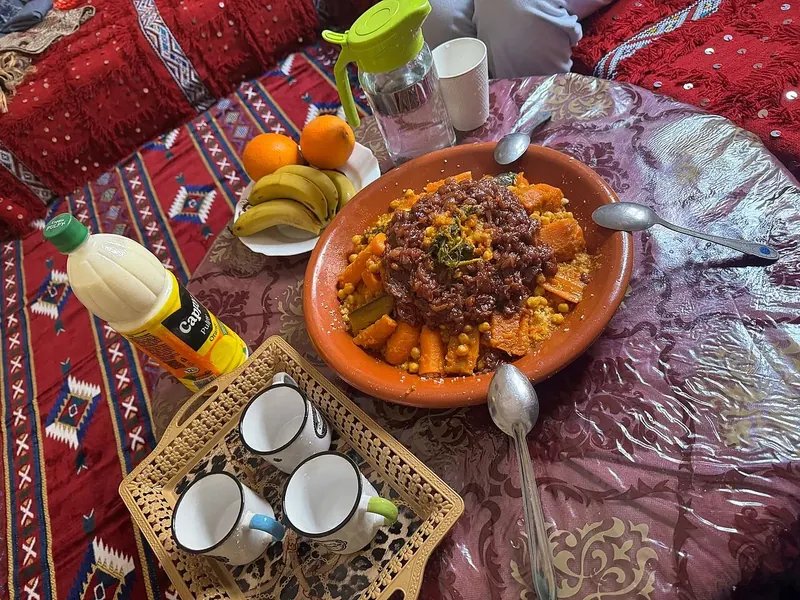
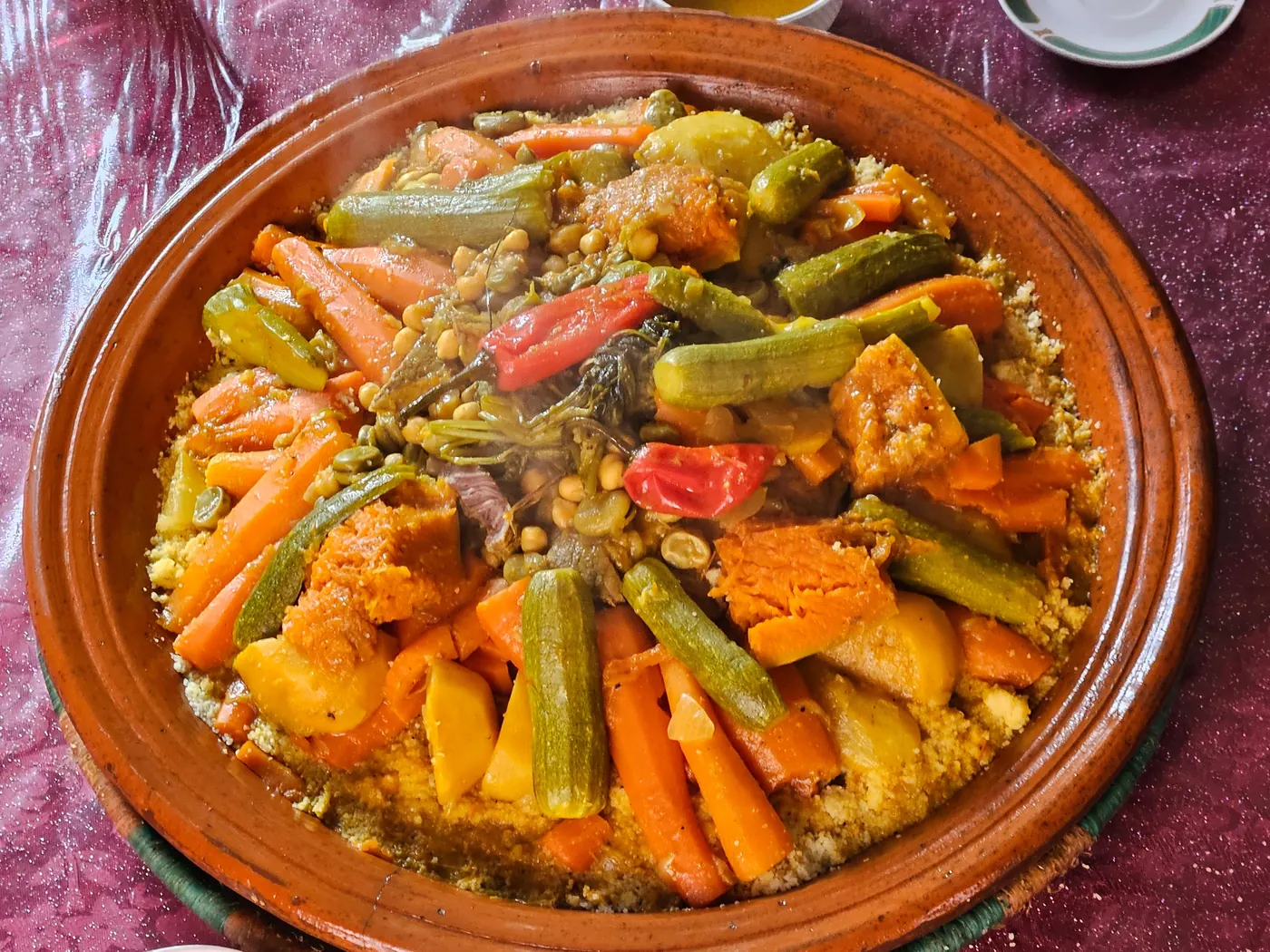
- Vegetable tagines and salads: ask about stock, butter or other animal ingredients, then ask whether the requested portion is prepared separately. A vegetable tagine may suit some diners, but its name is not an ingredient list.
- Couscous, bread and pastries: treat these as a direct gluten question. Ask whether there is a non-wheat alternative and whether the serving or preparation surface is shared.
- Soups, sauces and braises: ask what gives the liquid its body and flavor. This catches meat stock, dairy, flour or an allergen-containing paste that may not be visible on the plate.
- Breakfast and sweets: ask separately about egg, milk, butter, honey, nuts, sesame and wheat. A plant-based-looking spread or pastry can still be unsuitable for your restriction.
- Shared dishes: decide in advance whether bread, serving spoons and communal dipping create a cross-contact concern for you. Ask for a separate portion before anyone begins eating.
This is not a warning against Moroccan food. It is a way to replace guesswork with a specific conversation. If a staff member understands the question and can check, you have useful information. If they cannot, choose a simpler independently sourced option instead.
Build a reliable fallback before you need it
A fallback makes it easier to decline an unclear meal without missing the day’s plans. On arrival, identify a nearby grocery option and keep personally suitable, shelf-stable food for a delayed transfer, a long road day or a restaurant that cannot confirm its preparation. If you need to manage several meals, choose accommodation with cold storage or cooking access where practical.3
This is also the point to separate two risks that are often mixed together. The CDC says food and water standards can vary by destination and activity, and advises travelers to make safe food-and-drink choices and clean their hands before eating.1 Those hygiene measures can reduce some illness risks, but they do not establish that food is free of your allergen, gluten, dairy, egg or animal ingredients. Keep both checks: food handling for general travel health, and an ingredient/preparation conversation for your own restriction.
For a first restaurant meal, favor a place with enough time for the conversation over a rushed arrival, a fixed group menu or a last-minute tour stop. A simple safe meal you have confirmed is a better start than trying to maximize variety on day one.
Use extra caution with tours, classes and shared meals
A food tour is not automatically unsuitable, but it can add variables: multiple kitchens, changing vendors, shared tastings and a schedule that moves on even if one stop cannot accommodate you. Before paying, send the exact restriction in writing and ask whether the operator will verify it with each venue on the actual date. Ask what the replacement is if a tasting cannot be made suitable, whether you may decline one item, and whether the tour has enough food for you without that item. Our Morocco food-tour guide can help you compare the wider format and route questions.
For a cooking class, ask for the recipe list, the ingredients used in sauces and garnishes, and the plan for shared boards, pans and utensils. A class can be a better fit than a moving food tour when it can agree a specific recipe in advance, but only if the cross-contact question has a clear answer. See the Moroccan cooking-class guide for broader format checks.
For family-style meals, request your portion first and separately if that is part of your medical plan. Do not assume a group host or guide can make a medical promise on behalf of a kitchen.
Prepare your medical and hygiene plan separately
Travel food preparation is not a substitute for personal medical planning. If you carry prescribed emergency medication, follow your clinician’s directions and transport plan. Food Allergy Canada advises carrying epinephrine devices in hand luggage rather than checked baggage, bringing extra prescribed devices and having translated allergy information; FARE also recommends carrying an emergency care plan with medication.2 3
Before departure, keep these items together:
- your clinician-approved emergency plan and any prescribed medicines;
- a written, exact-ingredient card and a copy stored on your phone;
- safe snacks for arrival and travel days;
- the location of medical help near each overnight base; and
- a clean-hands routine for meals, consistent with CDC travel-health advice.1
If your plans include several food-dependent activities, Maroc Mobility’s Personal Travel Assistant can help coordinate questions with independent providers. Provider menus, ingredient handling, confirmation and medical suitability remain the provider’s responsibility, so obtain their answer directly before relying on it.
A calmer first day
Start with one confirmed meal, a small backup supply and time to communicate. Then expand your choices as you learn which accommodations and restaurants respond clearly. Travelers heading to Fez can also use our upcoming Fassi food and dining guide to understand regional dining choices, while keeping this same ingredient-and-preparation standard. A careful plan does not promise a risk-free meal; it gives you a clear way to decide when the answer is good enough and when it is time to choose another option.