Decide the trip shape before booking a car
For a Marrakech return, treat Merzouga as a six-day, five-night loop, not a three-day dash. Use two nights to reach the dunes, keep a full day or second night at Merzouga, then use two days to return through Ouarzazate. If you only have four days, make Merzouga the end of a southbound route and continue north later; do not promise yourself a relaxed Marrakech loop as well.
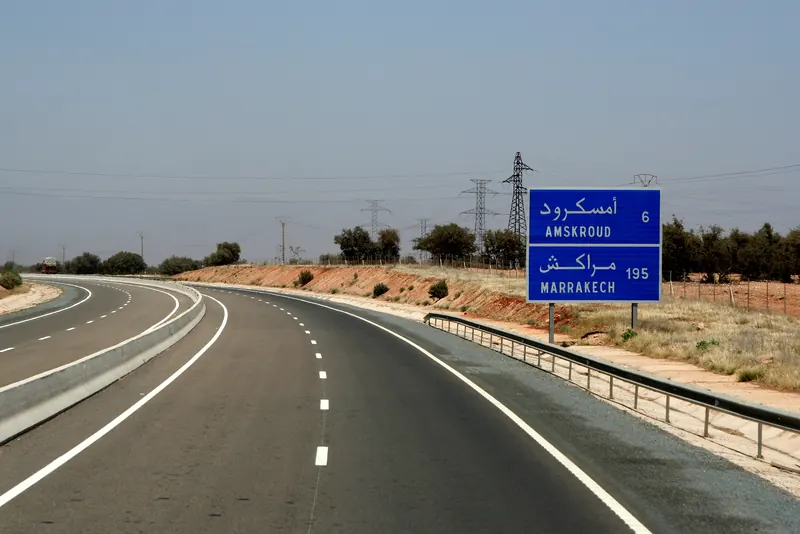
A recent local route guide estimates the direct Marrakech–Merzouga corridor at about 560 km and 9–10 hours at the wheel before stops. That is a useful scale check, not a real-time journey promise: traffic, weather, roadworks, photo stops and accommodation access can all change the day. 4
| Route shape | Nights and direction | Choose it when | Main trade-off |
|---|---|---|---|
| Marrakech return loop | 5 nights / 6 days | You want a proper Merzouga stay and the same rental return branch | You retrace part of the southern corridor |
| Marrakech to Merzouga, then continue north | 3 nights / 4 days to Merzouga | You have an onward route and can add later travel days | It is not a complete Marrakech round trip |
| Four- or five-day Marrakech loop | Only if you remove a stop or the second Merzouga night | You accept a transfer-led trip | Little margin for road conditions or a missed camp transfer |
The outline below assumes a normal paved-road trip, a daylight-only plan and a rental that has specifically accepted every driver. For transport alternatives, start with the Marrakech–Merzouga travel guide before committing to a car.
A six-day Marrakech return itinerary
Day 1: Marrakech to Aït Benhaddou or Ouarzazate
Collect the car early enough to complete the inspection before leaving Marrakech. Photograph the exterior, wheels, glass, fuel level and mileage; make sure the condition record matches. Do not turn an airport collection, a medina hotel checkout and an Atlas crossing into one rushed morning.
Choose either a night near Aït Benhaddou or in Ouarzazate. The first is the quieter heritage stop; the second usually gives a more straightforward town base for fuel, food and an early departure. Aït Benhaddou is a UNESCO-listed earthen ksar in Ouarzazate Province, so approach it as a heritage visit rather than a box to tick from the roadside. 3 Confirm parking and the walking distance to the room with your accommodation before arrival.
Day 2: Ouarzazate to Dadès or Tinghir
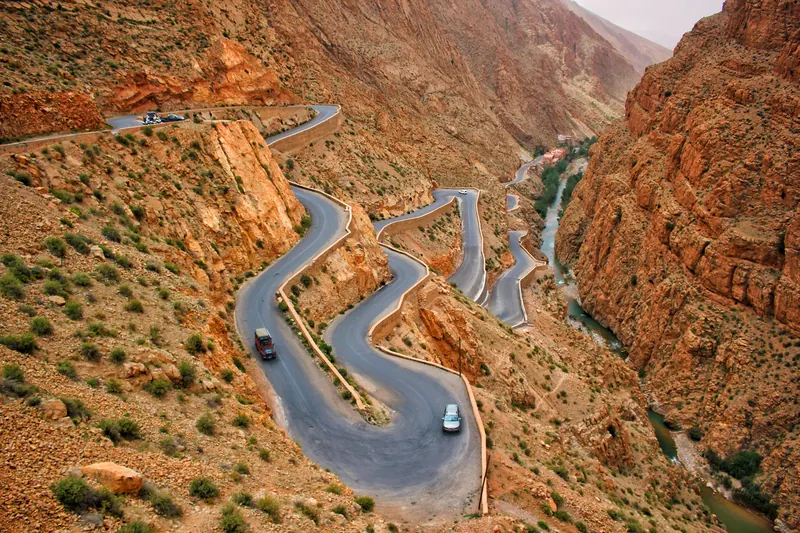
This is the day to choose one valley experience, not to claim every gorge. A Dadès-area night works if the gorge road and landscape are a priority. A Tinghir-area night makes more sense if you would rather have a slower Todra Gorge stop the following morning. Both keep the next day to Merzouga more manageable than pushing straight from Marrakech.
Keep the final part of the day simple: check in, refill water, confirm the next lodging and download offline navigation while you have reliable connection. Do not book an evening activity that requires a precise arrival time after a mountain or valley drive.
Day 3: Dadès or Tinghir to Merzouga
Leave with enough daylight to arrive at the accommodation meeting point rather than merely the word “Merzouga” on a map. Before setting off, get four details in a message: the exact place to park, the latest time a camp transfer can leave, whether the transfer is by 4x4 or another arrangement, and whether main luggage stays in the vehicle or at a lodge.
If you are sleeping in the dunes, carry a small overnight bag and leave only what the provider has agreed to store. If you are sleeping in the village or at the dune edge, use the evening to settle in rather than adding a long off-road excursion. A standard rental reaching the town is not evidence that it is allowed or suitable to reach every camp approach.
Day 4: Keep Merzouga as a real stop
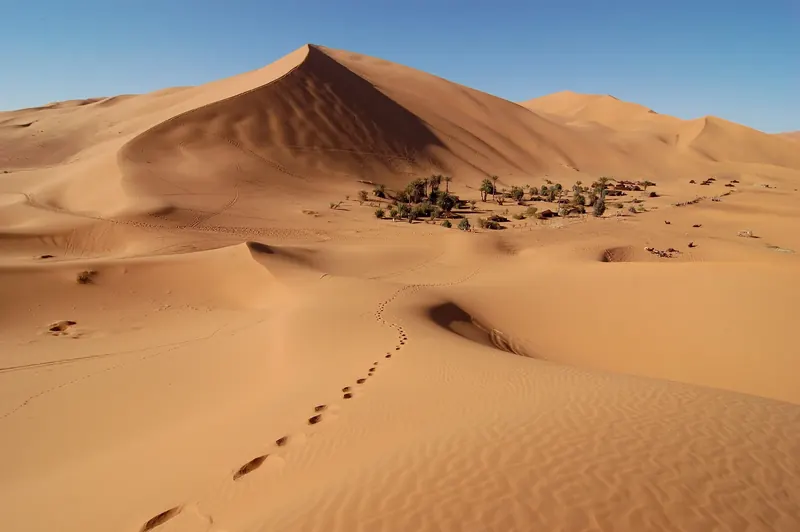
Use this day to make the desert stay worth the drive. Choose a second night in Merzouga if you want both a camp transfer and time at a village or dune-edge property, or if you need a weather and fatigue buffer. The separate Merzouga travel guide and desert-camp guide explain the stay and camp-access questions that a road itinerary should not guess for you.
A one-night camp can work, but only if the provider has confirmed the transfer time, luggage handling, bedding, bathroom arrangement and next-morning departure plan. Those are provider terms, not inclusions that can be assumed from a “desert camp” label.
Day 5: Merzouga to Ouarzazate
Retracing to an Ouarzazate-area night is not a failure of imagination. It is the buffer that lets you leave the dunes in daylight, refuel in established towns and avoid forcing a long rural leg after dark. Keep the return day deliberately lighter than the outbound route: do not add a fresh gorge detour simply because it appears nearby on a map.
Day 6: Ouarzazate to Marrakech
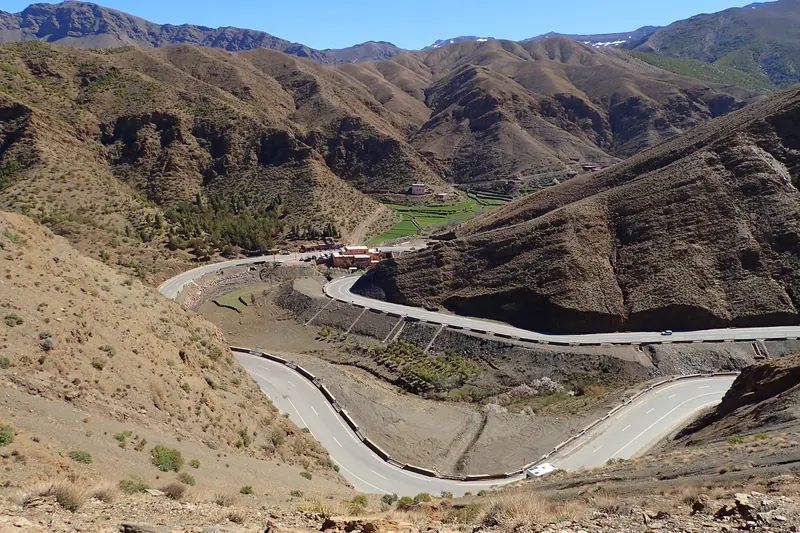
Check the road situation before crossing the High Atlas and leave a margin for the rental return. If your flight departs soon after this day, move the final night to Marrakech instead of trying to cross the mountains, refill the car and hand it back under airport time pressure. The focused High Atlas driving guide is a useful next read for this final crossing.
Put the route before the stops
The southbound corridor has more potential stops than a sensible itinerary can absorb. Give each driving day one main place to explore, then let the road itself take the rest of the attention.
- Aït Benhaddou suits the first day when heritage architecture is the priority. Do not treat its earthen lanes and viewpoint as a guaranteed quick stop; allow time to park, walk and respect the site.
- Dadès Gorge is a worthwhile optional diversion for drivers who want a valley overnight. It is not compulsory for a route that already includes Tinghir or a fixed Merzouga check-in.
- Todra Gorge fits better when Tinghir is the overnight base and you prefer a short walk between canyon walls to a longer scenic-road diversion.
- Merzouga is the destination, not a fuel stop before a camp. Put the camp or lodge handover on the itinerary before adding Rissani, Erfoud or another excursion.
This is why the itinerary uses separate valley and desert days. The decision is not which photograph is “best”; it is whether you can reach your next confirmed parking or transfer point before dark.
Rental, licence and insurance checks for this route
Three different rule sets apply. Keeping them separate prevents a common booking mistake.
- Driving documents are legal requirements. Guidance is specific to the licence-issuing country. For example, the UK government currently says a British driver in Morocco needs the original UK licence and the 1968 International Driving Permit, and says Morocco no longer accepts the 1949 version. That UK guidance is not a rule that can safely be copied to a U.S., Canadian, EU or other licence. 1
- Rental eligibility is the supplier’s policy. Minimum age, years since licence issue, residency or nationality checks, licence language, additional-driver approval, the physical payment card and deposit authorization can differ by company, branch and vehicle class. The same UK guidance notes that hire companies often impose a driving-experience requirement and a higher minimum age. 1
- Insurance and waivers are contract terms. Liability cover, a damage waiver, the excess and a deposit hold are not the same thing. Nor does any of them automatically permit unpaved or off-road use. The named supplier’s written terms decide whether the camp approach, recovery and breakdown assistance are covered. Read the rental insurance and collection guide alongside the contract.
For a U.S.-licensed driver, send the pickup branch this exact question before paying: “Will you accept my original U.S. state licence for this rental? Is an IDP required, and if so which convention? What minimum age and licence-holding period apply to every named driver? What physical card, deposit authorization and passport documents must the lead driver present?” Keep the reply with the booking. This is more reliable than assuming a rule for one nationality applies to another.
Before leaving Marrakech, also obtain written answers to these route-specific questions:
- Is every named driver shown on the agreement, and does the agreement state the pickup and return branch hours?
- What is the excess, what is held on the card, and when is that authorization released under this supplier’s process?
- Does roadside assistance cover this paved itinerary, and whom should you call before arranging a tow?
- Is the vehicle permitted on the exact final approach to the named camp, or must it be left at a meeting point?
- Where is the spare wheel or repair kit, and how should a puncture or collision be reported?
A 4x4 is not automatically required because the destination is the Sahara. Select a vehicle for passengers, luggage, transmission confidence and contract-permitted road surface. Do not turn a standard rental into an off-road vehicle by assumption.
Decide whether to return or continue after Merzouga
Returning to Marrakech is simplest when the round-trip car contract, flight and six-day pace align. It protects you from a one-way drop-off surprise, but requires the two return driving days above.
Continuing north after Merzouga can make more geographic sense on a longer Morocco trip, but it is a different itinerary. Before booking, confirm that the company allows a different-city return, the exact staffed handover location and hours, the one-way charge, fuel policy, and what happens if a delay moves the return outside office hours. A map pin is not a contractual return arrangement. See the one-way rental guide if a different return city is part of the decision.
If the only way to reach a flight is to cross the Atlas after dark or to skip the confirmed camp handover, change the plan. Take a later flight, add a Marrakech night, shorten the route, or choose an organised journey rather than treating fatigue as a normal part of self-driving.
Check live road status twice
Do a road check the evening before the Atlas crossing and again on departure morning. Morocco’s Ministry of Equipment says its road-operability service publishes periodic road-condition bulletins and route-change information, with a 24/7 information centre and the Maroute app among its channels. Its notices cover disruptions from snow, floods, sand, rockfall and landslides. 2
Use that official update to make a go, wait or reroute decision; do not rely on a blog’s old “road is fine” statement. The UK government also warns that poor lighting makes night driving riskier and that secondary and mountain roads can be especially hazardous in poor weather. 1
A restrained next step: If you want help pressure-testing this route’s overnight sequence, lodging access and supplier questions while keeping the rental, insurance and camp contracts with their actual providers, see Maroc Mobility’s travel-assistant service.