Why visit Asilah
Asilah (also written Assilah) is on Morocco’s northwestern Atlantic coast, south of Tangier. Its appeal is unusually concentrated: a compact old medina, white and blue façades, public art, stone fortifications and a beach-town setting. It rewards walking slowly more than trying to tick off a long attraction list. Britannica describes its changing political history and its present role as a fishing port and summer resort; the layered past is visible in the fortified edge rather than in a single museum visit. 1
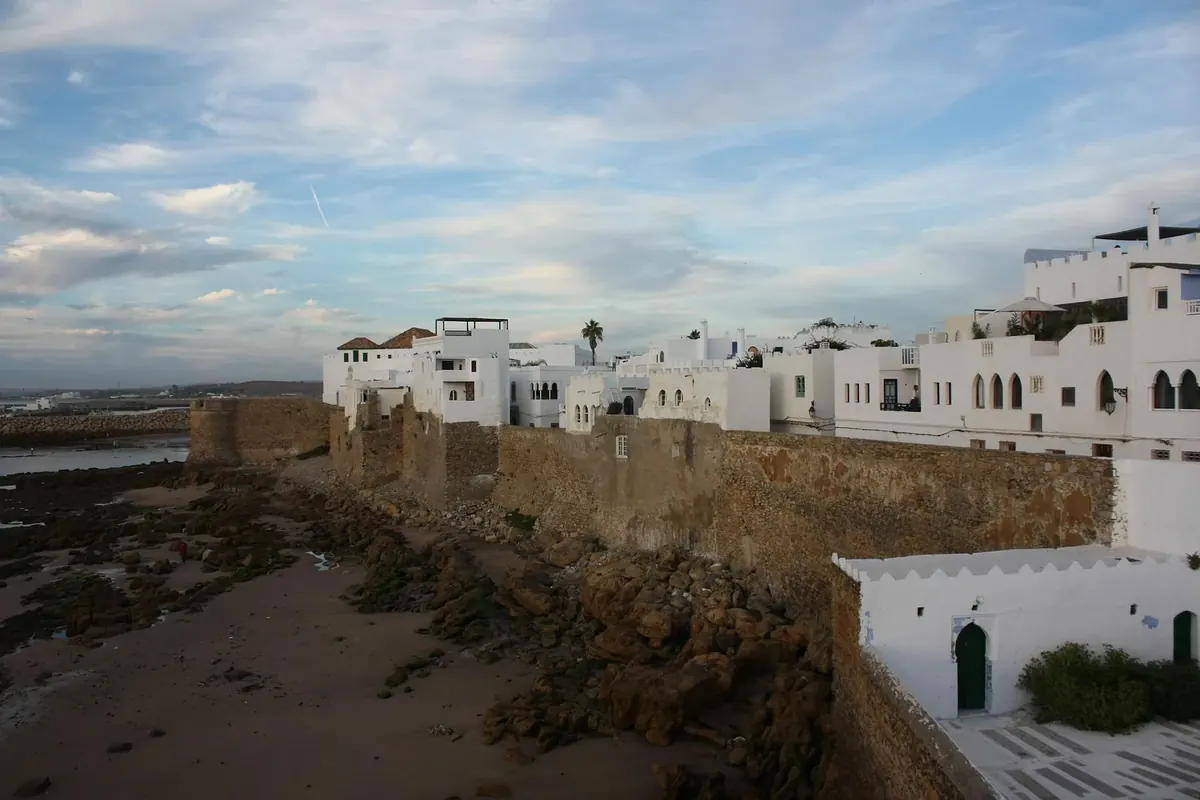
The medina is small enough to explore without a formal guide, but it is still a lived-in neighborhood. Begin near Bab Al Kassaba and allow yourself to follow side lanes instead of using a rigid route. Lonely Planet notes the medina’s 16th-century Portuguese fortifications, white buildings, blue details, boutiques and galleries; seasonal festival murals and work by local schoolchildren add to the visual texture. 2 Expect quiet residential corners as well as photogenic walls. Keep doorways clear, ask before photographing people, and remember that a colorful wall may be someone’s home rather than a backdrop.
A useful walking route through the medina
Enter by Bab Al Kassaba, the main northern entrance identified by Lonely Planet, then walk toward the Great Mosque and the denser central lanes. Non-Muslim visitors should admire the exterior rather than plan on entering the mosque. Follow the streets at an easy pace, looking for small galleries, craft shops and murals in open public areas. Since artworks are repainted and can fade, the pleasure is finding what is actually there that day, not tracking down a promised list. 2
Continue toward the sea-facing fortifications. The wall is not an uninterrupted public promenade: access to the ramparts is limited, and the southwestern bastion is noted as a good ocean outlook. 2 If that section is closed or crowded, don’t climb barriers or enter restricted spaces. Instead, circle back through public lanes and enjoy the view from accessible openings along the coast. The old gate Bab Homar and its eroded Portuguese royal emblem are another detail to look for on the southern side. 2
This loop can be comfortably compact, but it grows when you stop for tea, browse shops or wait for changing light. If you have just a few hours, prioritize medina lanes and the sea wall rather than adding a distant beach, meal and market all at once. Lonely Planet identifies Thursday as the town’s main market day; that can add everyday bustle, but it also means busier streets, so allow extra time if you prefer quieter photography. 2
Murals, history and what changes
The painted walls are not simply a permanent outdoor gallery. The Asilah Cultural Moussem began in 1978 through local cultural organizers and artists, combining public murals with workshops, exhibitions and other programs. MoMA’s post documents the effort to involve local residents and use art in public space as part of the town’s cultural and social renewal. 3 That background helps explain why it is better to approach the murals as community-made work than as scenery created solely for visitors.
The appearance of the medina changes over time. Some murals are repainted, others weather away, and newer works may appear in different lanes. The town’s summer cultural program is a reason many visitors time a trip for festival activity, but do not assume that a specific event, artist, schedule or fresh mural will be present on your dates. Seek a current announcement from organizers before making the festival the centerpiece of a trip. If you arrive outside the program, the town and surviving murals are still worth seeing. 2 3
The stone walls also carry a complicated history. Asilah was occupied by Portugal in 1471, then passed through Spanish control before returning to Moroccan rule in 1589, according to Britannica. 1 The fortifications are therefore a visible reminder of successive powers on a strategic coast, not a reason to reduce the city to a European-style fortress story. Pair the wall walk with time in the active medina, where local commerce and contemporary art matter as much as its historic fabric.
Asilah beach: make it a separate plan
The Atlantic setting invites a swim, but distinguish the medina’s rocky, wall-edged shore from broader sandy beaches outside the historic core. Lonely Planet describes beaches in and around Asilah as a draw, while its medina notes focus on the seawall and limited rampart access. 2 Decide whether your priority is a coastal stroll or a proper beach break: the second may require a taxi or other local ride, time to return, and a check of current conditions and access. Do not count on walking from every medina lodging directly to a suitable swimming stretch.
For a beach-focused half-day, ask your lodging or a local driver which beach is accessible and appropriate for your season, and agree how you will return before setting out. Facilities, food availability, wind and water conditions vary. Bring sun protection, water and a layer for a breezy coast; do not rely on a beach vendor or lifeguard being present. If swimming matters to your trip, choose the beach based on that day’s local conditions rather than the prettiest image online.
Tangier to Asilah: day trip or overnight?
Asilah is close enough to Tangier to consider as a day excursion, but the decision should hinge on real door-to-door connections for your date. Morocco’s rail operator ONCF provides an official timetable and journey-planning interface; check whether a suitable train serves your exact origin and destination and verify the station names before relying on rail. 4 For a road trip, compare coach or shared transport with a prearranged driver based on where you are staying, luggage and how much flexibility you need. Confirm the return before departure, particularly if you are trying to make an evening connection from Tangier. Avoid planning around third-party journey times or quoted fares without checking current operator information.
A day trip works best when you want the medina, lunch and a short seaside walk. Leave room for station transfers and delays rather than treating the timetable as the time you will spend exploring. If the only workable return is early, you may rush through the best part of town. An overnight makes sense if sunset, a slow meal, a cultural event or a separate beach outing matters to you. Choose accommodation according to access: a medina guesthouse brings you close to the old lanes, while a property outside the walls may be easier for vehicle drop-off or mobility needs. Ask in advance about stairs, luggage handling, vehicle access and late arrival.
Before you buy a ticket or arrange a driver, compare the full journey: getting from your Tangier lodging to the departure point, arrival-side transfer into Asilah, time available in town, and the last return connection. If the connection involves changing operators, treat each leg separately and leave a buffer. A private ride can simplify door-to-door logistics, but it costs more and must be agreed directly with the provider; there is no need to buy a tour merely to walk around the medina. For broader itinerary help, the site’s Personal Travel Assistant is one optional planning service; transport and other providers remain independently arranged and charged.
Where to eat, stay and how long to allow
Seafood is a natural choice in a coastal town, and Lonely Planet notes seafood-focused menus alongside Spanish-influenced tapas and wine. 2 Menus and opening patterns vary, so ask what is fresh and available rather than expecting a particular dish. If you have an allergy or dietary restriction, explain it clearly and confirm preparation details with the restaurant; do not assume a dish can be adapted safely. Carry some cash as a backup for smaller purchases, but check accepted payment methods before relying on cards.
For a first visit, a few unhurried hours can cover the medina and ramparts. Add time for a meal and a beach only when the beach is truly part of the plan. One night is a sensible choice for travelers who dislike watching the clock or want both town and shore. Asilah is not a substitute for Tangier’s larger urban sights; it works best as a contrast to the city or a deliberately slower coastal stop. Travelers following the existing Tangier guide or Tangier–Chefchaouen transport guide can fold it into a north-Morocco route without trying to see every nearby destination in one day.
Practical details to confirm
The medina’s narrow lanes and uneven paving are not ideal for every mobility level. If step-free access is important, ask accommodation about the route from drop-off to the room and consider visiting the walls only where public access is straightforward. A stroller may be more cumbersome than a carrier on rough lanes. Families can make the compact center manageable with breaks, but supervise children near the seafront edge and on uneven stones.
In summer, heat and visitor numbers can make midday wandering less pleasant; outside summer, coastal wind or a changeable day can make a light layer useful. Check cultural-event details, beach access, transport schedules, business opening patterns and any required bookings close to travel. The medina is primarily an open public neighborhood, not one attraction with a universal entrance ticket. Respect prayer spaces and private homes, and never treat a closed gate or rampart as an invitation to find another way in.