Is Volubilis worth visiting?
For travelers interested in archaeology, architecture or the layered history of northern Morocco, yes. Volubilis offers more than scattered columns: its remains preserve a planned urban center, public buildings, residences and mosaic floors within a broad rural setting. UNESCO describes a 42-hectare property and traces the settlement from prehistory through the Islamic period, including its earlier role as a Mauritanian capital and later importance under Roman rule.1 The site became briefly significant again in the Idrisid era; nearby Moulay Idriss is linked to Idris I.1
That long timeline is the key to seeing the place well. The Roman structures are visually dominant, but the site is not evidence of a simple one-way story of Rome replacing local society. UNESCO characterizes Volubilis as an interface among Roman and indigenous cultures and identifies Punic, Roman, African, Christian and Arab-Islamic influences in its urban development and decoration.1 Let that complexity shape your visit: look at how civic monuments, domestic spaces and the surrounding fertile landscape fit together, rather than treating the triumphal arch as the whole attraction.
Volubilis is especially worthwhile if Meknes is already on your route, or if you want to make a deliberate day from Fez that combines the ruins with Meknes and possibly Moulay Idriss. It is less compelling as a stand-alone excursion from a distant city when the journey consumes much of the day and leaves only a brief walk among the remains.
What to look for on site
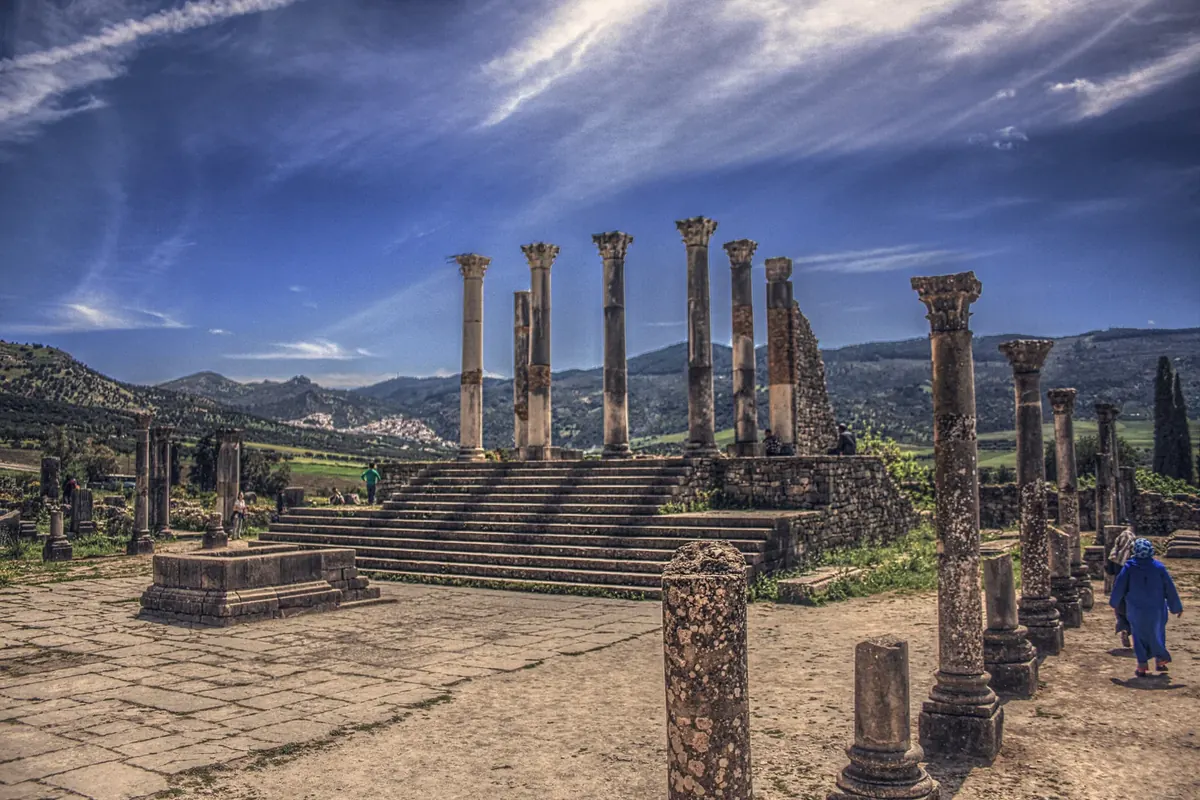
Begin with the overall layout. The monumental core gives a sense of civic life: the forum, basilica and Capitol occupy the more organized part of the ancient town, while other sections follow rougher, sloping ground. UNESCO notes both a regular urban plan and a terraced layout on the hillier southern and western areas.1 That shift in terrain helps explain why the site feels like a real city landscape rather than a compact museum courtyard.
The Arch of Caracalla is the obvious landmark, but it makes more sense when viewed in relation to the route through the public center. Nearby columns and the basilica’s surviving arches help you imagine the scale of civic space. Move slowly enough to notice foundations, street alignments and changes in elevation; the less monumental fragments show how a city extended beyond its postcard view.
Mosaics are among Volubilis’s most memorable details. The Meknes tourism office notes that mosaics decorate ancient residences and are a major reason for the site’s reputation.2 Take time to inspect visible floors rather than photographing them from a distance: identify the borders, repeated shapes and figures, and consider how a floor belonged to a room and household. Do not step onto or touch archaeological surfaces. Their survival depends on conservation, and the World Monuments Fund describes past work that included mosaic conservation, monitoring soil movement and moisture, and establishing restoration methods.3
A guide can add context to inscriptions, architectural fragments and mythological scenes that might otherwise look like attractive patterns. Whether to hire one depends on your interest and travel style: independent visitors can focus on the visible structure and landscape, while a qualified guide may be worthwhile if you want a narrative that connects the remains to the region’s different eras. Confirm credentials, language, duration and fee directly before starting; current arrangements are not established by the historical or heritage sources cited here.
Getting to Volubilis from Meknes or Fez
Meknes is the logical base for the last leg. The Prefectural Council of Tourism of Meknes places Volubilis about 28 kilometers from the city and describes road access via the N13 corridor, as well as bus and taxi options from Meknes.2 Because local services and departure points can change, ask at your accommodation or a current local information point about the day’s actual service, where it leaves, how close it gets to the site and when the return runs. Do not assume a bus listed in a destination overview will match your preferred timing or drop you at the entrance.
A private car with driver is the simplest way to make a flexible loop, particularly if you plan to add Moulay Idriss or Meknes itself. Agree in advance on the full route, waiting time, return point, included stops and total charge with the provider. A taxi can be more economical or spontaneous, but clarify whether it is a shared or private ride, where the driver will wait and what happens if you want to extend the visit. The critical issue is not only reaching the ruins; it is having a dependable return plan from a rural site.
From Fez, consider the train or coach to Meknes followed by a separately arranged road leg, or book a coordinated excursion if you prefer not to manage the connection. The train does not take you to Volubilis itself. Meknes is the practical rail gateway; the final connection is by road, so check current rail schedules and onward transport for your date rather than planning around an assumed connection.4 A one-day Fez outing that includes Volubilis, Moulay Idriss and Meknes is possible as a deliberately organized itinerary, but it can become a sequence of short stops. If archaeology is your priority, spend more time at Volubilis and reduce the number of other sights.
For a flexible travel-planning conversation, the site’s Personal Travel Assistant service is available at $20 per inclusive Morocco calendar day; any independently provided transport or other services are arranged and charged separately.
How much time to allow, and how to combine stops
There is no single ideal visit length. A quick orientation and walk to the central monuments can fit a shorter stop; exploring the houses and mosaics at a more thoughtful pace takes longer. As a practical planning choice, reserve roughly two hours on site if archaeology is a main interest, then add road time and any separate stop. This is a planning allowance, not a promise about how long every route or visit takes. The terrain and the number of places you want to interpret will affect your pace.
Pairing Volubilis with Moulay Idriss makes geographical sense because the town is nearby and has a distinct religious and historical significance connected to Idris I.1 It is not merely another Roman attraction. If you visit, plan its medina and viewpoints as a separate experience, and be respectful of local religious life. Then decide whether Meknes deserves a few hours of its own or a separate day. Trying to squeeze all three into a tight timetable may mean giving each place only a superficial glance.
A useful choice is to identify your priority before you leave:
- Mosaics and archaeology: go directly to Volubilis, arrive with enough time to walk the site carefully, and consider a guide.
- A varied day: combine the ruins with a limited visit to Moulay Idriss or Meknes, but confirm the driver’s waiting and return plan.
- Independent, lower-cost travel: investigate current public transport from Meknes, then verify the final connection and return before committing.
Prepare for an exposed archaeological site
Wear closed or stable walking shoes. Ancient paving, broken stone and uneven ground are part of the experience, but they also make thin sandals or wheeled luggage impractical. The site occupies a broad hillside setting; bring water, a hat and sun protection, and avoid assuming there will be shade whenever you want a break. Choose a cooler part of the day when possible, especially in warm months, and check the forecast before setting out.
Accessibility deserves an honest check. A study of Volubilis’s tourism needs identifies maintained paths and mobility access as important issues, and notes weaknesses in parts of the path network.5 That is not a current route audit, so a traveler who needs step-free access, a mobility aid or frequent seating should contact the site or a local operator before traveling. Ask specifically about the entrance, surface, gradients, accessible facilities and the route to the monuments you most want to see. A companion or driver cannot remove every surface barrier.
Bring cash as a backup and confirm current admission and payment methods from a reliable local source before departure. The Meknes tourism page publishes a fee and opening window, but its details may not reflect later changes.2 Likewise, do not rely on old guidebook pages for opening hours, seasonal closing time, ticket price, café service or guide rates. Check on the day or shortly beforehand. If you are traveling with children, set a simple meeting point and explain that mosaics and stonework are fragile and must not be climbed on.
Common planning mistakes
Underestimating the final connection. Meknes may be an easy rail stop, but the archaeological site lies outside the city. Arrange a return, not just an outbound ride.
Trying to see everything too quickly. A brief walk to the arch does not represent a visit to the wider site or its domestic mosaics. Pick a realistic combination of stops.
Arriving without basic comfort supplies. Long exposure, limited shade and uneven surfaces can make an otherwise rewarding visit tiring. Water and stable footwear matter more than elaborate gear.
Treating operational details as permanent. Hours, ticketing, transport and visitor services can change. Confirm them directly rather than treating a cached web listing as a guarantee.
Reading the site as only Roman. Volubilis is important precisely because its archaeological record spans distinct periods and cultural exchanges.1 Leave room for that broader story.