Decide which Taghazout you want to stay in
Taghazout is often described as one beach destination, but trip planning is easier if you distinguish the older village from the larger Taghazout Bay resort development. The village is a compact base for cafes, surf shops, guesthouses and walking to nearby breaks. Taghazout Bay is a more resort-oriented area with larger hotels and facilities; it is not interchangeable with staying on the village's narrow lanes. The national tourism office presents the wider area as a surf and seaside destination, while recent travel reporting documents the contrast between the traditional village and expanding resort area. 1 2
Before booking, open the property on a map and ask where the entrance and drop-off point are. The word “beachfront” does not tell you whether the place is in the village, in the resort area, or near a particular surf break. Ask whether there are stairs, how far luggage must be carried, whether the property can arrange a pickup, and whether breakfast, boards, lessons or transfers are included or separately charged. If anyone in your party has limited mobility, get specific answers about the route from vehicle to room and from room to beach; steep streets and uneven walking routes can matter more than straight-line distance.
A village stay generally makes sense if you want to walk among cafes and surf operators and don't mind a busier, more compact setting. A larger resort can suit travelers who prioritize on-site dining, pools or spa-style facilities and are comfortable arranging transport for village outings. National Geographic's reporting notes both surf guesthouses and larger branded resort properties, but availability and facilities should be checked directly for your dates. 2
Match the surf break to the surfer, not the postcard
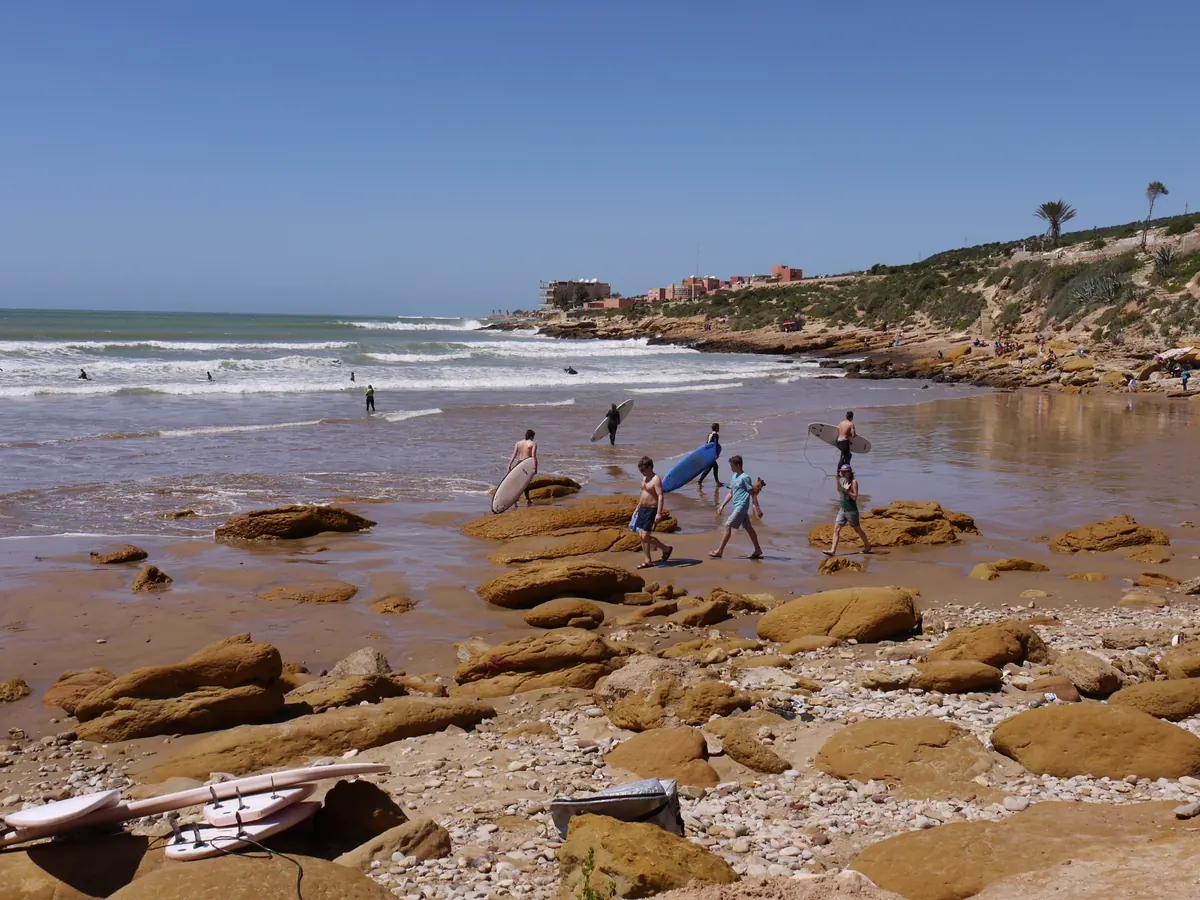
The coastline around Taghazout has several named breaks rather than one uniform beginner beach. Morocco's tourism office highlights Anchor Point and Killer Point as favorites for experienced surfers. National Geographic identifies Banana Beach and Panoramas as gentler starting options in its guide, and Anchor Point and Boilers for more advanced surfers. These are useful orientation points, not a live forecast: swell, tide, wind, crowding and a visitor's ability can change whether a spot is appropriate on a given day. 1 2
If you are new to surfing, book an instructor who assesses the day's conditions and takes you to an appropriate learning area. Ask what the lesson price includes before you commit: transport to the break, board, wetsuit, instruction time and any pickup may be separate. If you already surf, do not assume a famous point break is suitable just because it is near your lodging. Check the entry and exit, rocks, current, crowd level and local right-of-way norms with someone who knows the break. Do not paddle out beyond your competence to keep up with a group.
Season can shape the trip, but don't treat a month as a wave guarantee. Travel accounts commonly frame the cooler part of the year as more attractive to experienced swell-seekers and warmer shoulder or summer periods as potentially gentler for lessons; conditions vary, so confirm with surf schools close to travel. If surfing is the central reason for the visit, allow more than one day: a single session can be lost to conditions, fatigue or a busy lineup. A flexible schedule lets an instructor choose a safer, more suitable session rather than forcing a lesson into a fixed itinerary. 3
Plan the Agadir arrival and the last mile
Agadir is the practical gateway for most visitors flying into the region. Taghazout lies north of the city, and an airport arrival still leaves a road transfer to your lodging. For a late arrival, surfboard luggage, children, or a property away from the village center, prearrange a pickup and get the drop-off point in writing. Ask whether the quoted transfer is private or shared, how much luggage it can take, and what happens if your flight is delayed.
There is local and interurban public transport in the Agadir area, but the official ALSA page reviewed provides map links rather than a clearly stated current airport-to-Taghazout service, timetable or fare. Use the operator's current route map or customer service to verify whether a bus meets your exact journey, then factor in the connection from its stop to your lodging. Do not plan a tight flight connection based on an old blog schedule or assume a local bus will take surfboards and luggage conveniently. 4
A rental car is useful if you plan to visit several beaches or inland sights, but it is unnecessary for every village-focused stay. Compare the cost and hassle of parking, local traffic and navigating property access with occasional taxis or a prearranged driver. If renting, check the vehicle and insurance terms and avoid arriving at an unfamiliar lodging after dark without confirming parking and directions.
Plan a good day even if you don't surf
A non-surf day can be deliberately simple: breakfast in the village, a walk to a beach viewpoint, a long lunch and an unhurried afternoon. Taghazout's appeal is not limited to getting into the water; reporting describes cafes, small shops, restaurants and wellness activities alongside the surf scene. Treat specific businesses in published lists as leads rather than guaranteed current openings. 2
For a more active outing, Paradise Valley is an inland excursion toward the Atlas foothills. It is a separate trip, not a beachside stroll. National Geographic describes a winding drive and recommends water and sturdy footwear for the terrain. Ask what the outing includes, how much walking is involved, whether swimming is expected, and what transport returns you to Taghazout. Recent rain or local conditions may affect trails and pools, so verify before setting out. 2
For a mixed-interest group, keep the surf session and inland outing on different days. That way non-surfers are not left waiting through a lesson and surfers are not expected to recover quickly before a road trip. A second example: if your group wants resort downtime as well as village dining, choose a property for the facilities you will genuinely use and plan one village evening with a confirmed ride back, rather than selecting a remote resort solely for the word “Taghazout” in the listing.
Treat the Atlantic as a changing natural environment
Taghazout's coastline is exposed to Atlantic surf, not a guaranteed calm swimming bay. The tourism office itself contrasts the stronger Taghazout waves with calmer water in Agadir Bay. A beach that looks inviting from shore can still have powerful surf, currents, rocks or changing water quality. Ask accommodation staff, a qualified surf instructor or local authorities about conditions on the day; follow posted instructions and do not swim alone or enter rough water to reach a photo spot. 1
Avoid turning older online comments about water quality into a current safety assessment. Rain and other local events can affect coastal conditions, and the sources reviewed here do not provide a live Taghazout beach-quality result. If the water looks unusually discolored or has debris, or you hear a local warning, stay out and check a current official or local update. Families should select a supervised, suitable shoreline activity rather than assuming every beach is safe for children.
The surf-tourism boom also creates pressure on coastal communities and infrastructure. Condé Nast Traveler reports concerns raised by local industry and environmental voices about crowding, waste and water quality along Morocco's surf coast. Its examples include other towns as well as the Taghazout region, so they should not be read as a claim that every Taghazout beach has a specific current problem. Visitors can still make low-impact choices: carry a reusable bottle, take litter away, respect residential spaces, and consider locally run lessons or lodging after checking what the provider actually offers. 3
A short pre-booking checklist
Before you pay, confirm the property area, exact map pin, check-in time, stairs or access constraints, cancellation terms, and what meals or surf services are included. For lessons, ask about ability grouping, equipment, transport and the plan if conditions are unsuitable. For airport arrival, agree the transfer and fallback if a flight is late. For a swim or surf session, get a same-day local conditions check. This is more reliable than relying on a directory listing's old price or timetable.
If your trip spans several Moroccan regions, avoid treating Taghazout as a quick detour between long travel days. Give the coast enough time for a surf day, a weather-flexible day and a slower village day. If you want help coordinating separate independent providers, see our Personal Travel Assistant service; accommodation, transport, lessons and activities are booked and charged by their respective providers.