Choose the experience before you choose the route
The best Morocco adventure travel plans begin with an honest choice: do you want physical mountain time, enormous sand dunes, a short desert-flavored escape, or time on the Atlantic? Morocco can contain all four, but each asks something different of your time, budget and energy. A package that says "desert and Atlas" may still spend far more time in a vehicle than outside.
Think in experience types rather than trying to collect every headline place. The Atlas rewards people who want to walk, climb or spend time in mountain communities. Merzouga is the choice for a true Sahara landscape. Agafay is the practical option when Marrakech is your base. The Atlantic is for travelers who prefer surf, wind, beach towns and a more flexible rhythm.
This is not a reason to avoid a multi-stop trip. It is a reason to decide what deserves the unhurried part of it. If one activity is the reason you are flying to Morocco, give it enough time for a weather change, an altered road plan or simply a slower day.
Atlas Mountains: choose the right level of effort
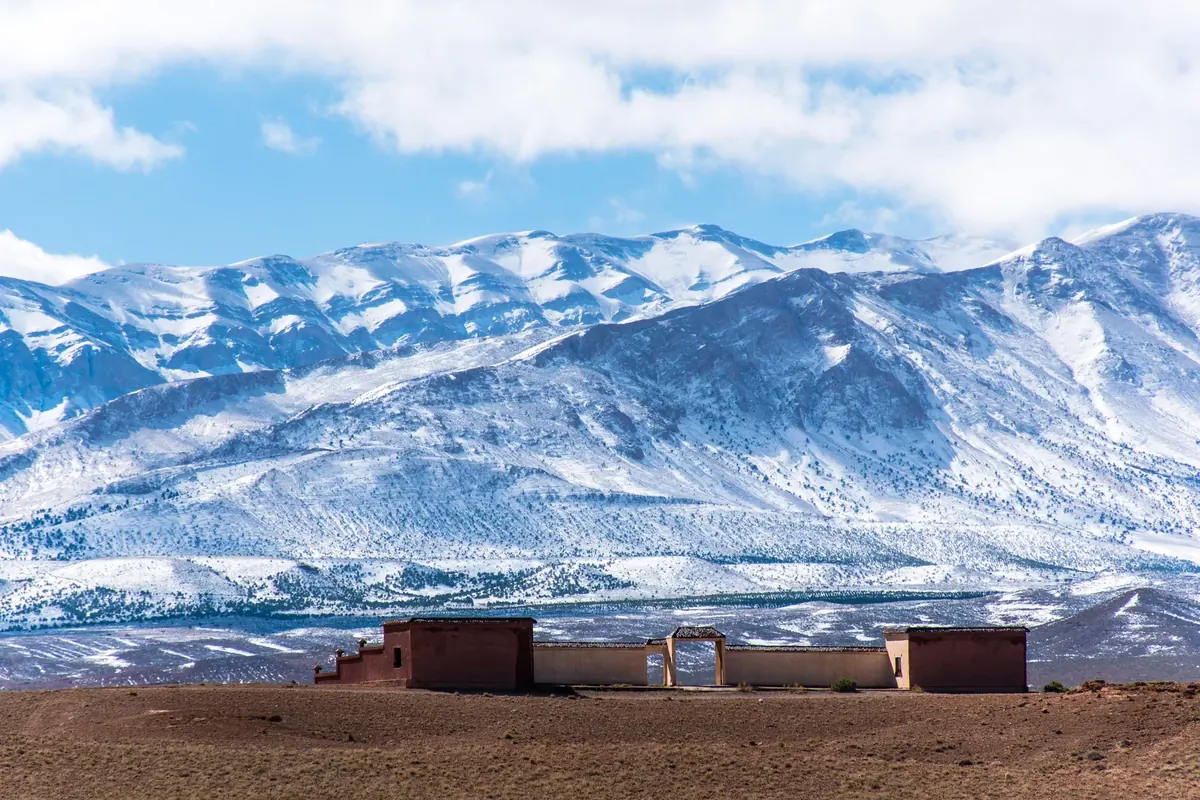
The High Atlas is Morocco’s most obvious mountain setting. The range includes Jbel Toubkal, which the Moroccan National Tourist Office identifies as North Africa’s highest peak at 4,167 meters (13,671 feet). 1 That fact alone is a useful expectation-setter: a summit objective is not the same product as a scenic valley walk.
For an active but less technical-feeling experience, look for a guided day walk or a village-to-village trek in an area such as Aït Bouguemez. Ask the operator to describe the terrain, ascent and descent, walking hours, vehicle access, group size and what happens if weather changes. Those answers matter more than a label such as "easy" or "adventure."
A Toubkal-focused trip needs a more serious conversation. The tourism office describes the trek from Imlil as a two- or three-day undertaking with mountain-hut overnights. 2 Conditions, access arrangements and individual readiness can change, so obtain current details directly from a suitably qualified local provider. Do not let a dramatic summit photo substitute for an assessment of your comfort with altitude, uneven ground and a multi-day effort.
The Atlas also works well for travelers who want a landscape-and-culture experience without a summit ambition. A slower walk, a rural overnight and time for local food or crafts can be more satisfying than moving on immediately after a viewpoint. Keep photography considerate: ask before making close portraits or photographing private homes and daily work.
Desert choices: Merzouga for dunes, Agafay for proximity
A true Sahara experience near Merzouga
For the classic image of large orange dunes, focus on the Merzouga area and Erg Chebbi. Morocco’s tourism office describes Merzouga as a gateway to the Sahara and Erg Chebbi as a landscape of dunes, palm groves, tracks and hikes; it also lists dromedary caravans and bivouacs among its popular experiences. 3
That setting is best for travelers whose priority is the landscape itself: a sunset or sunrise in the dunes, a walk on sand, a camp stay, or simply enough quiet time to notice the scale of the place. It is not a quick add-on to Marrakech. The journey is part of the commitment, so read the transfer plan carefully and ask what portion is driving, what stops are planned and when you will actually arrive at the camp.
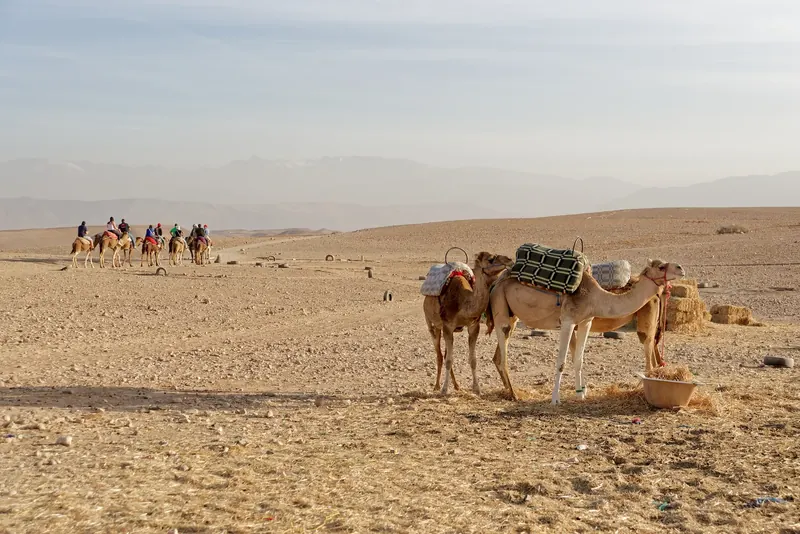
Be precise about what a "desert camp" includes. Confirm whether bags are transferred, how you reach the camp, what the sleeping and bathroom arrangements are, whether meals and water are included, and how a weather disruption is handled. If camel riding is offered, ask how long the ride is, how animals are rested and watered, and whether walking is an available alternative. A responsible operator should be able to answer directly.
Agafay desert distance from Marrakech and travel time
Agafay answers a different need. The official Marrakech destination site places it about 40 kilometers from Marrakech and describes a rocky desert of hills and broad open expanses, not the classic sand dunes of the Sahara. 4 It can make sense for a sunset, outdoor activity or overnight without committing to a long cross-country transfer.
There is no single trustworthy Agafay travel time to promise. Your actual journey changes with the Marrakech pickup point, road conditions, traffic and the location of the camp or activity. Ask for the exact pickup and return window, not just a drive estimate. Leave a margin if you have a dinner reservation, a flight or another fixed commitment afterward.
Set your expectations correctly: choose Agafay for its convenience, rocky landscape and Atlas-facing atmosphere. Choose Merzouga when tall dunes and a deeper Sahara setting are the non-negotiable experience. Neither is "better" in the abstract; the mistake is paying for one while expecting the other.
Atlantic coast: make water time the point
Morocco’s coast gives an adventure trip a completely different character. The national tourism office names Dakhla, Safi, Essaouira and Taghazout among places associated with surfing, kite surfing and windsurfing. 5 The right choice depends on the sport, your ability, the local forecast and the conditions on the day—not a generic claim that a destination is always suitable.
For a first lesson or a return-to-sport session, favor an operator that explains the day’s conditions, group size, instructor supervision, equipment and what happens if the sea or wind does not cooperate. Ask where the activity takes place and whether transport is included. More experienced travelers should still confirm the break or launch, equipment needs and rescue arrangements locally rather than relying on last season’s reports.
A coast-first adventure is often the best counterweight to Marrakech’s intensity. It can also be the better choice for a group with mixed appetites: one person can take a lesson while another enjoys the town, beach or food scene. That flexibility is valuable, but it should not become an excuse to ignore local guidance around water conditions.
How to evaluate Marrakech travel packages without buying a vague promise
Marrakech travel packages range from one-night Agafay outings to private multi-stop journeys involving the mountains, desert and coast. Compare the substance, not the adjective. "Luxury," "authentic" and "adventure" do not tell you whether the actual plan fits you.
Before booking, get a written description of the pickup point and transfer lengths, accommodation or camp standard, meals, named activities, guide or instructor role, equipment, group size, exclusions and cancellation terms. For a multi-stop plan, ask who is responsible for each handoff and how an itinerary change is communicated. If an answer is unclear, assume that element is not included until it is confirmed in writing.
Then inspect the pace. A plan with several long road segments may be perfectly worthwhile if the drive itself is part of your goal. It is a poor fit if your priority is walking, dunes or time in the water. Build the trip around one or two high-value experiences rather than treating them as photo stops between transfers.
For a multi-stop journey where real-time coordination would be useful, the site’s Personal Travel Assistant offers 24/7 WhatsApp and call assistance during purchased dates. Providers confirm and charge separately for transport, stays and experiences.
Make the adventure lighter on places and people
Responsible travel is mostly visible in ordinary decisions. Carry refillable water where practical, keep rubbish with you until it can be disposed of properly, and stay on agreed paths rather than widening tracks around dunes, trails or cultivated ground. A beautiful setting is not an open-air set.
Give communities some control over the encounter. Ask before taking close photos, avoid treating people’s homes as attractions and buy crafts or meals only when you actually value them. A locally based guide can help with language and context, but respect is still the visitor’s job.
For animal activities, ask calm, concrete questions before committing: How long is the ride? Is walking possible instead? Where do the animals rest and drink? Are there weight or time limits? Skip an activity if the answers are evasive or if an animal appears distressed. The same principle applies to motorized desert activities: know where the route goes, how close it comes to settlements or fragile terrain, and whether a slower, lower-impact option is available.
Finally, do not mistake remoteness for an absence of planning. The U.S. Department of State currently advises U.S. travelers to exercise increased caution in Morocco and specifically notes that safety oversight and medical response may be more limited outside major tourist areas. It advises awareness in remote areas and avoiding isolated camping in favor of guarded campgrounds. 6 Check the live advisory before departure, share your plan with someone you trust, keep essentials accessible and follow local weather, road and guide instructions.