Decide whether El Badi fits your day
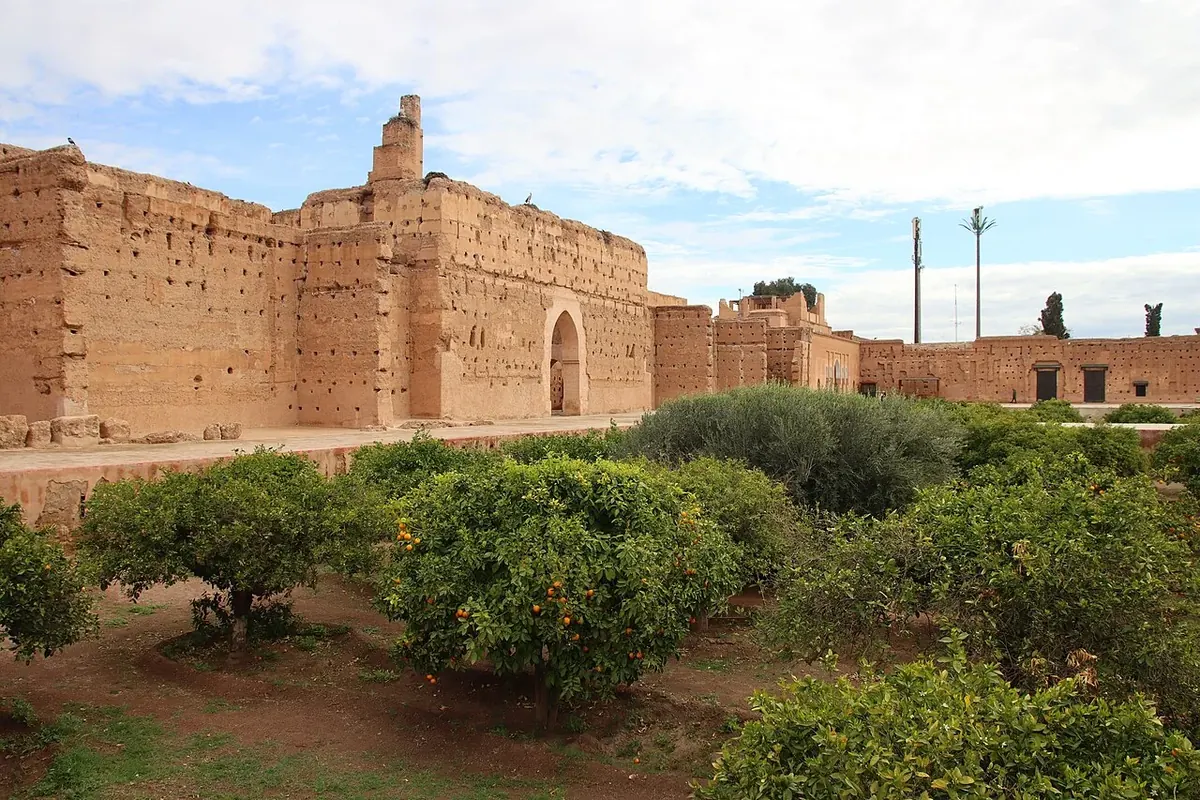
El Badi Palace is most rewarding if you are curious about what a powerful royal complex looks like after its decoration and building materials are gone. Its expansive courtyards, high earthen walls and traces of planted or water-filled spaces give a strong sense of scale. You are visiting surviving ruins, not rooms furnished to recreate the Saadian court. UNESCO identifies the ruins of Badiâ Palace among the monuments contributing to the historic Medina of Marrakesh’s heritage value. 1
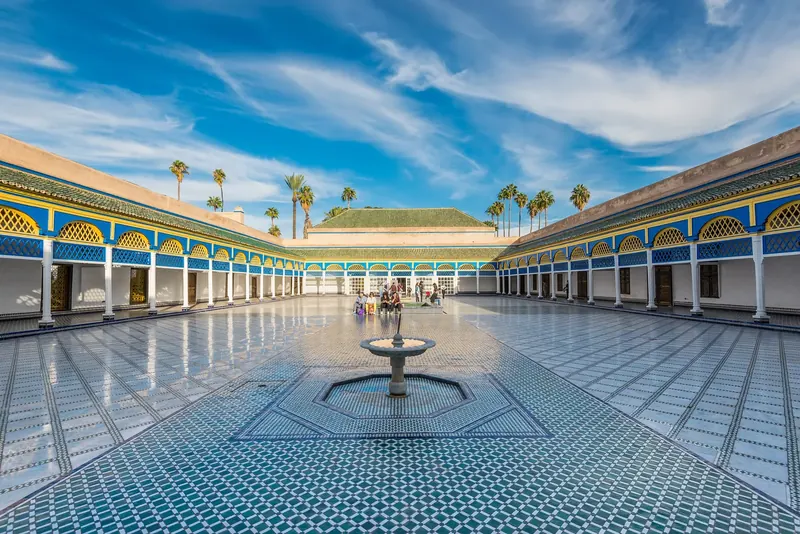
That distinction helps set expectations. If you want tilework, carved ceilings and a more intact palace atmosphere, Bahia Palace is usually the better single choice. El Badi and Bahia are not substitutes: one is a dramatic archaeological landscape, the other a decorated residence. If you enjoy architecture or have time for two monuments, seeing both makes the contrast especially clear. The Saadian Tombs are another nearby stop, but they are a separate site with their own entry arrangements.
El Badi may be less satisfying if you want dense interpretation at every turn or dislike walking outdoors in heat. Recent visitor accounts describe a large open ruin, with access or restoration conditions sometimes affecting what can be seen; reports are not a promise of present conditions. 2
What to look for inside the ruins
Begin by noticing the plan before chasing details. The broad central space and long enclosing walls communicate the scale of the former complex. Look for the relationship between courtyard, sunken garden areas and water features, then compare those low spaces with the height of the surviving walls. The empty spaces are part of the story: they make it easier to imagine the original ensemble without mistaking modern restoration for original decoration.
The palace’s identity is tied to the Saadian period and to Marrakesh’s role as a royal center. UNESCO describes Badiâ as a later architectural jewel of the Medina and specifically lists its ruins among the city’s major monuments. 1 Keep claims about precise construction dates, imported materials or room counts cautious unless you are using a reliable interpretive guide on site; popular retellings can differ. A good guide can supply historical context that the bare remains do not explain on their own.
Look up at the ramparts as well as down into the courtyard. Birds may nest in the high walls, but sightings vary with season and activity; do not plan the visit around guaranteed storks. Some areas may be closed for repair, an event or conservation work. Stay behind barriers and do not climb on masonry or enter restricted spaces.
Tickets, hours and what to verify
The Moroccan Ministry of Youth, Culture and Communication’s e-services page lists El Badi Palace as open from 9:00 to 17:00 and shows a foreign-adult ticket at 100 dirhams, a foreign child ticket for ages 7–13 at 50 dirhams, and different rates for Moroccan or resident visitors. It also states free entry for people with reduced mobility and specified free-entry days for Moroccan nationals. 3 These are the portal’s displayed details, not a guarantee that schedules, concessions or the full site will be unchanged on your date. Check the official listing before setting out.
The same Ministry page has a notable apparent content inconsistency: its description text discusses a palace commissioned in 1886 and an eight-hectare complex, which does not match El Badi’s Saadian identity. Use that page for its displayed ticket and hours information only; do not rely on that description as El Badi history. 3
The Ministry site offers a ticket-purchase path, but buying online does not mean every visitor must prebook or that every third-party ticket is equivalent. Before paying a reseller, confirm the exact attraction, date, inclusion (entry only versus guided visit), currency, cancellation terms and whether a timed slot is involved. Avoid assuming a guided-tour price includes the admission ticket unless the booking terms say so.
Schedules can change for holidays, conservation work, events or operational reasons. If your itinerary is tight, check the official page on the day or shortly before; do not build a nonrefundable next activity around an unverified closing time.
How to plan the visit
Treat the palace as a flexible outdoor stop rather than a quick indoor museum. A reasonable plan is to allow roughly an hour or more if you like to pause, explore the perimeter and read or listen to interpretation; this is a planning suggestion, not an official visit duration. Visitors who move quickly may spend less, while photography, a guide or restricted areas can change the pace.
Go earlier in the day if you prefer to walk before the strongest midday sun, but confirm the actual opening information first. Carry drinking water, sun protection and shoes that feel secure on uneven surfaces. The courtyard has little shade compared with an indoor attraction, and exposed stone or packed surfaces can feel hot. Do not count on finding refreshments or a quiet shaded seat within the complex.
If you want historical narrative, decide before arrival whether to hire a licensed local guide or use a reliable audio or printed source. A guide can help explain how a ruin once functioned and distinguish visible evidence from reconstruction. Agree on the language, duration, price, and whether entrance is included before starting. If you prefer to wander independently, read a short history beforehand and use the site as a spatial experience rather than expecting every feature to have a label.
For travelers with mobility needs, contact the site or ticket operator in advance about the current route, surfaces, seating and accessible facilities. The Ministry listing indicates free entry for individuals with reduced mobility, but free admission does not establish that every part of the historic site is step-free or accessible. 3 Ask about the exact route you can use rather than relying on a general accessibility label. Families with young children should agree on a meeting point and keep children away from edges and unstable masonry.
Pair it with the right nearby stop
A compact south-Medina outing can combine El Badi with the Saadian Tombs, Bahia Palace or the Mellah, but do not treat the attractions as one ticket. Check each place’s current hours and entry separately, and leave time for walking, finding entrances and breaks. If you only have part of a day, choose one palace based on your interests and add a nearby neighborhood walk or meal rather than racing between every landmark.
A useful comparison is: El Badi for scale and ruin; Bahia for ornate rooms and decoration; Saadian Tombs for a focused visit to a royal necropolis. UNESCO lists these as distinct later monuments within Marrakesh’s heritage context. 1 For a first-time visitor who wants both architecture and variety, El Badi plus Bahia gives a stronger contrast than two similar indoor museum stops. For a slower day or limited walking capacity, pick one main site and keep the rest optional.
Use a map to identify the actual gate and approach from your starting point. Medina walking distances can feel longer in heat or crowds than a straight-line map suggests. If you are arriving by car or taxi, ask for a practical drop-off point and confirm the remaining walk; do not assume a vehicle can reach the entrance. For help coordinating independently booked transport or timing, see our Morocco travel assistance page.
Common mistakes to avoid
The first mistake is arriving expecting an intact palace. El Badi’s value lies in what its remains reveal about scale, layout and loss. The second is treating a ticket price or operating hours found in an old travel post as current; consult the Ministry listing shortly before travel. 3
Also avoid packing the visit into the hottest part of the day without water, assuming that every section or rooftop will be open, or planning a rigid sequence that leaves no room for a closure. The third-party visitor page includes reports of restoration and reduced access, which illustrate why conditions should be checked rather than assumed. 2 Finally, do not confuse El Badi with Bahia Palace when buying tickets or arranging a guide; verify the venue name on the confirmation.
A practical decision
Choose El Badi if you want an evocative open-air ruin and are willing to supply some of the historical imagination yourself. Choose Bahia if architectural finishes and decorated rooms matter more. Choose both if you have enough time and energy to walk between separate sites. Confirm ticket details and access shortly before arrival, keep the day flexible, and approach the surviving fabric as a protected monument rather than a place to climb or touch.