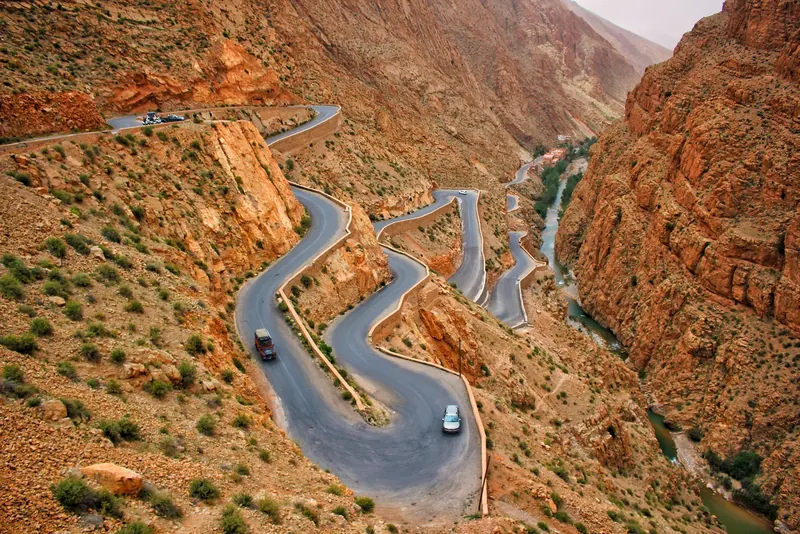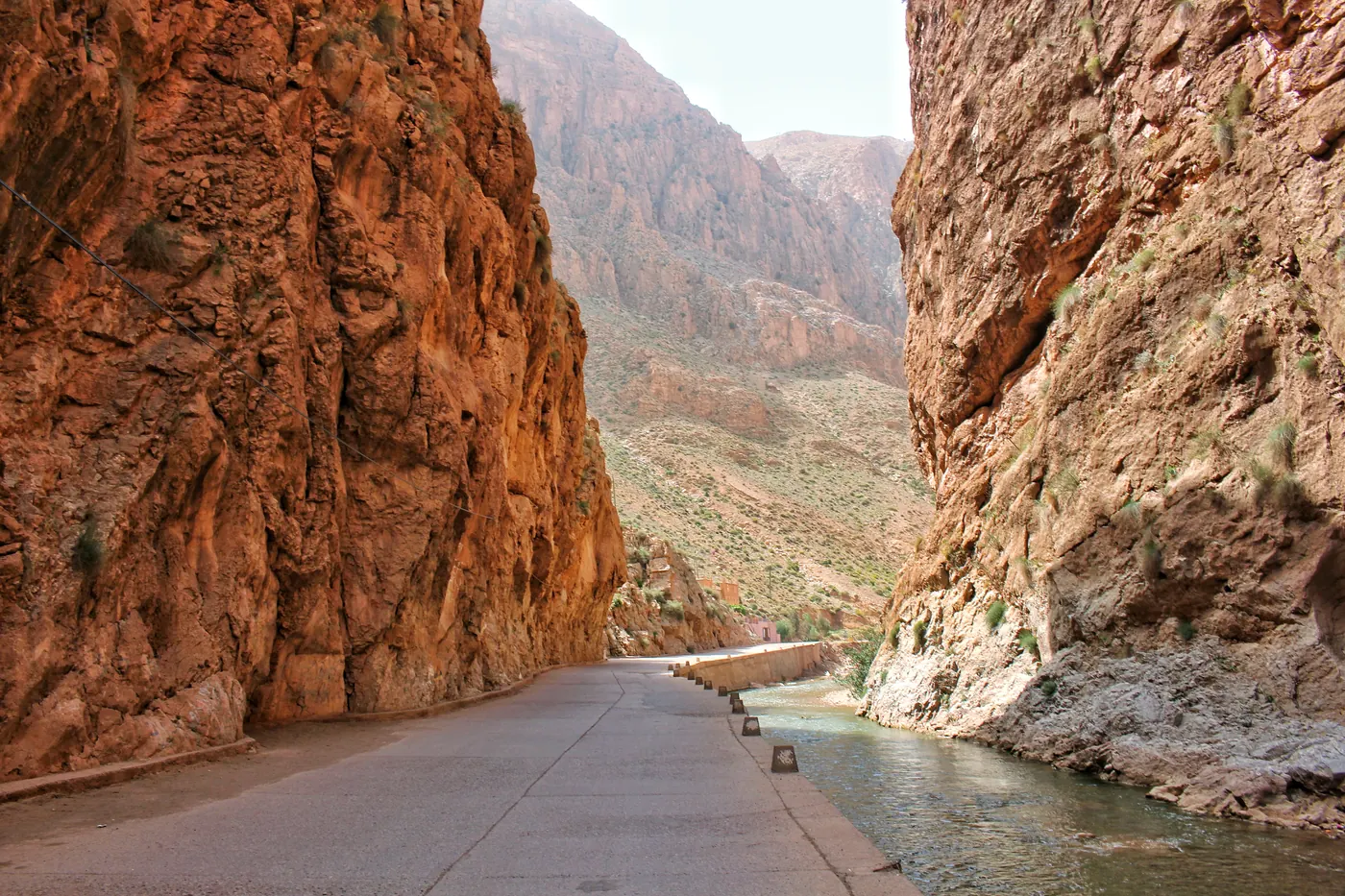
Choose Dades or Todra based on the day you have
If time is limited, choose Dades Gorge when you want the journey itself to be the attraction: the valley approach, roadside rock formations, pullouts and a possible night around Boumalne Dadès. Choose Todra Gorge when you want one concentrated, narrow-canyon stop near Tinghir, then to continue your route.
The two places belong to the same broad Ouarzazate–Zagora–Tinghir travel region, but they do different jobs in an itinerary. Morocco’s tourism authority presents both the Dades landscape and the Todra Gorges within that southern corridor. 1
The practical mistake is treating them as two interchangeable photo stops. A live Google Maps check on 30 October 2026 put Boumalne Dadès to Tinghir at 52.2 km and 54 minutes via N10. That is a useful corridor figure, not a visit plan: it excludes the side roads into each gorge, finding a lawful place to stop, walking, meals and any return to accommodation. Map estimates also change with conditions. 2
Choose the gorge by the decision, not a score
| If this is your priority | Choose Dades Gorge | Choose Todra Gorge |
|---|---|---|
| Your main experience | A driving-led valley sequence with viewpoints and rock formations | A concentrated encounter with a narrow gorge |
| Your route position | You can make Boumalne Dadès a deliberate stop rather than a late detour | You are already passing through Tinghir and want one clearly defined gorge stop |
| Your limited energy | You are happy to keep driving slowly, assess pullouts and make several short stops | You prefer to park, walk a short section at your own pace and keep the rest of the day simpler |
| Your overnight logic | A Dades-side overnight gives the road and valley more daylight | A Tinghir-side overnight protects a Todra visit from becoming the final task of a long drive |
| Your transport reality | You have a confirmed vehicle or driver for valley access and return | You have a confirmed ride to the gorge and a return plan; town transport alone is not enough |
This is a planning comparison, not a beauty contest. Dades has more value when your trip can absorb several small scenic decisions. Todra has more value when you need the gorge itself to deliver the stop. Neither choice is wrong; the poor fit is adding both after a long transfer simply because their pins look close on a map.
When Dades is the better use of a half-day
Choose Dades when you are willing to make the road part of the visit. The useful question is not “Can I reach the famous switchbacks?” but “Do I have daylight and attention for the road, the pullouts and the return?” A rushed arrival late in the day turns a landscape sequence into a stressful errand.
Dades also makes sense when Boumalne Dadès is already your practical base. You can arrive, sleep, then give the lower gorge a fresh daylight window before rejoining the wider route. If you are unsure how far to continue, which stops suit your vehicle or whether an upper-valley extension belongs in the day, use the detailed Dades Gorge road-stops guide rather than assuming every mapped line is part of the same easy outing.
Do not turn “Dades” into a promise of an off-road adventure. A lower-gorge sightseeing plan and a remote-road plan are different decisions. Ask a rental supplier or driver about the exact road you intend to use, current surface and weather, and any contract limits before leaving the paved route. That is supplier and road-specific information, not a national rule.
When Todra is the better use of a half-day
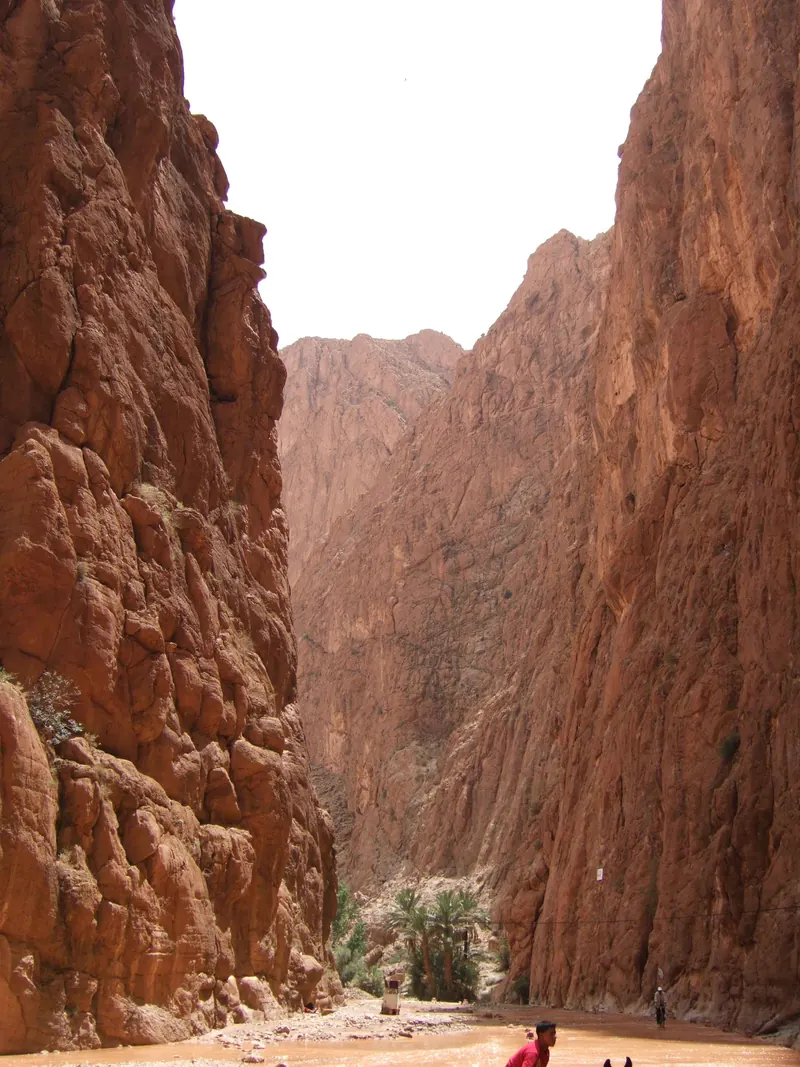
Choose Todra when your route already runs through Tinghir and you want the narrow gorge to be the clear focus. It works best as a deliberate stop with enough time to leave the vehicle, walk only as far as conditions and comfort allow, and return before the next long driving leg.
Keep the scale honest. A short gorge visit is not automatically a hiking day, and an appealing footpath is not automatically a maintained or weather-safe route. If you want a longer walk, climbing or a guided activity, treat it as a separate booking decision: confirm the provider’s route, equipment, price, insurance, age rules and weather cancellation policy in writing.
For a straightforward southbound or eastbound trip, Todra usually has the clearer “stop, see, continue” logic. That makes it the stronger choice when you have one gorge slot and do not want the driving to become the main attraction.
When both gorges genuinely fit
Doing both can be worthwhile, but only under a narrow set of assumptions: you are travelling by private car or a pre-arranged driver, your route already runs from the Dades side through Tinghir, and you have an overnight around Boumalne Dadès or Tinghir. It is not the right plan for a same-day out-and-back from Marrakech or for the end of an already full transfer day.
A sensible shape is to give Dades a daylight block on the Boumalne side, use the N10 corridor as a transfer rather than a sightseeing race, then see Todra in a separate daylight block from a Tinghir-area base. The 54-minute map estimate between the two towns is the floor for that transfer, not the time needed to complete two gorge visits. 2
If your wider journey continues to Merzouga, compare the gorges against your actual overnight chain in this Marrakech-to-Merzouga travel guide. A self-drive itinerary needs the same restraint: a gorge stop should not erase the daylight margin that makes the following road leg safer.
Make the transport choice before choosing the gorge
A rental car or pre-arranged driver gives the most control over stops. Morocco’s official tourism information also identifies taxis, coaches and rental cars as countrywide travel options, but a mode existing in the country does not guarantee a convenient last mile or return pickup at a particular gorge. 4
If you are not self-driving, use this five-question test before committing to either gorge:
- What exact place is the drop-off? A town, a hotel and the gorge entrance are not the same thing.
- Who takes you back, from where, and at what time? Get the return plan before leaving the main road.
- What happens if rain, darkness or a delay changes the plan? Ask whether the driver waits, returns, or has a contactable backup.
- Is the price per vehicle, per person or for a one-way leg? Have the currency, inclusions and payment method confirmed before departure.
- What will you skip if transport runs late? Name one non-essential stop in advance rather than trying to recover time by rushing.
For the broader decision of whether a car adds enough value to this kind of route, see how to plan a practical Morocco road trip.
Keep road and weather risk out of the “which is prettier?” question
Do not use a fixed online drive time as a safety margin. UK travel advice for Morocco warns that poor weather can make secondary and mountain roads especially hazardous, and that heavy rain can cause flash flooding in mountains and near rivers. 3 Check local conditions on the day, follow authorities’ instructions, and change the plan if visibility, water or road access is uncertain.
This matters more in Dades because the road is central to the experience, but it also matters at Todra: a short planned walk is not worth forcing during poor conditions. Avoid driving after dark where possible; poor lighting makes other vehicles, pedestrians and animals harder to see. 3
A two-minute choice checklist
Choose Dades only if you can answer yes to all three: “I have a daylight road window,” “I want several scenic stops rather than one main canyon,” and “I can end nearby or continue without rushing.”
Choose Todra only if you can answer yes to all three: “Tinghir is already on my route,” “one narrow-gorge stop is enough today,” and “my return or onward transport is clear.”
Choose both only if you can also say: “I have an overnight between them or beside one of them,” “I will not use the transfer estimate as sightseeing time,” and “I have a weather fallback.” Otherwise, pick the gorge that fits the overnight you already have.
Need a second opinion on how these stops fit your dates and transport style? Maroc Mobility’s Personal Travel Assistant can help you plan the sequence and coordinate with independent providers; their bookings, prices and terms remain separate.