Start with a small, mixed order
Moroccan pastry is a broad counter category, not one standard dessert. For a first purchase, take a small mixed selection instead of committing to a large gift box: one almond-led piece, one sesame-and-honey piece, and one cookie-style piece make the differences easy to taste. Add a briouat only after confirming whether the batch is sweet or savoury.
The four useful starting points are kaab el ghazal or gazelle horns, chebakia, ghriba, and sweet briouats. Morocco’s National Tourist Office describes gazelle horns as crushed almonds in thin pastry scented with orange blossom; it identifies chebakia as a Ramadan pastry, and ghriba as an almond-and-semolina sweet that is often sprinkled with sesame. 1
This is deliberately a buying guide rather than a list of “best” shops. A pastry’s filling, production day, price, storage advice and dietary suitability belong to the particular seller and batch in front of you.
A pastry stop can be as simple as one item and a drink. The mint tea café etiquette guide explains how to keep that café order clear, including the practical difference between a short stop and wider hospitality.
Choose your first pastry by taste and travel fit
| Choose this | What to expect | It fits if you want | Ask before buying |
|---|---|---|---|
| Gazelle horn / kaab el ghazal | A pale crescent of thin pastry around an almond filling, commonly perfumed with orange blossom. 1 | A floral, almond-forward sweet to have with tea or to include in a small gift selection. | “Does this contain almonds, other nuts, butter or egg, and how should I keep it?” |
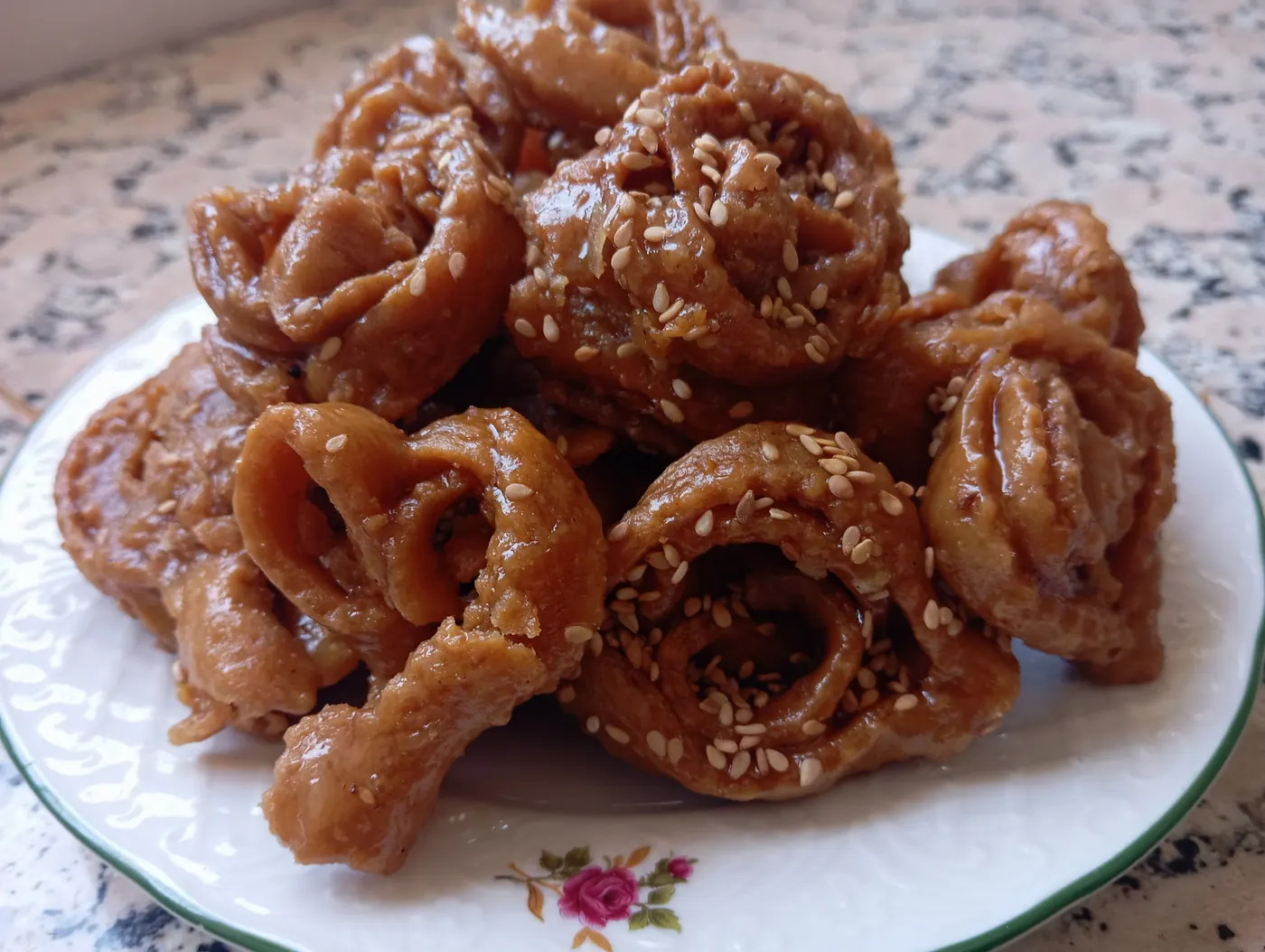
| Chebakia | A glossy, folded pastry associated with Ramadan and commonly finished with sesame. 1 | A richer, honeyed-sesame taste and a seasonal reference point. | “Is this batch sesame- and honey-based, and is it best eaten today or packed?” |
| Ghriba | A crumbly cookie-style sweet; the official tourism description names almond and semolina, often with sesame. 1 | A simpler tea-time texture rather than a filled pastry. | “Which flavour is this, and does it contain wheat, nuts, dairy or egg?” |
| Sweet briouat | A filled pastry; the national tourism information distinguishes honey briouates from savoury briouates filled with chicken or minced meat. 1 2 | A filled sweet, provided you have confirmed the version at the counter. | “Is this the sweet version? What is the filling and how should it be stored?” |
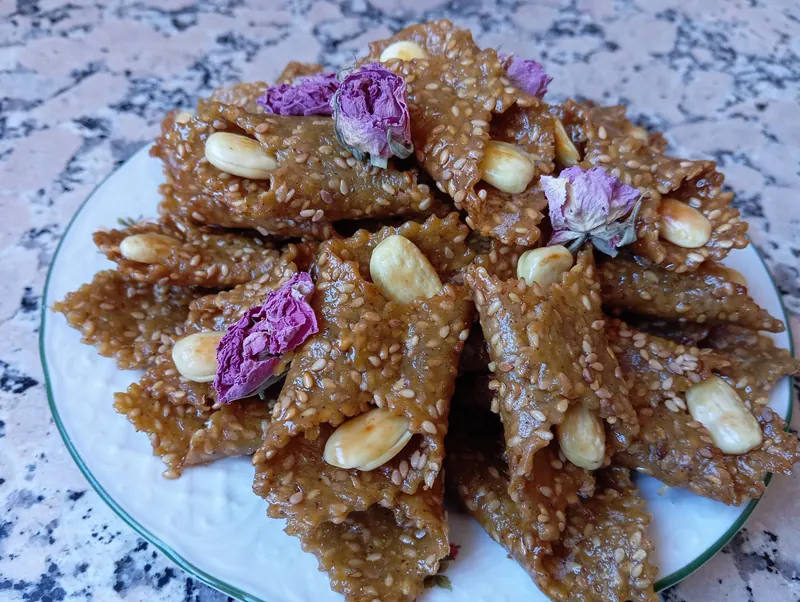
A tray can contain more than these four names. The photographed Beligha above is another Moroccan pastry, but its visible sesame and almonds are not an ingredient statement for every pastry on a counter. Treat appearance as a prompt to ask, not as proof of what is inside.
Buy from the counter with a clear plan
Decide the job of the purchase before choosing. Eat-now sweets can be selected for curiosity and texture. Hotel treats need storage instructions. Gifts or travel-home sweets need a firm box, a realistic journey time and a destination-rule check. This prevents a common mismatch: buying a beautiful assortment first, then discovering that it is awkward to carry or unsuitable for a member of the group.
Ask to see the total before the item goes in the box. There is no reliable countrywide pastry price, portion size or payment policy to quote: a seller may price by piece, by weight or as a prepared box. Confirm the unit, the total, the payment method and whether the box is included. If you want a mixed order, point to each piece or have the seller repeat the selection before packing.
Do not equate a smart display, a queue or a decorated gift box with a universal freshness standard. Ask when the batch was put out, how the seller recommends keeping it, and whether the product is intended for same-day eating. If the answer matters to your plans, get it before paying rather than relying on a general blog rule.
Ask five questions before you pay
A short, specific conversation is more useful than trying to identify every pastry by sight. These questions work at a patisserie, a market counter or a hotel pastry display:
- What is inside this one? Ask separately about nuts, sesame, wheat, dairy, eggs and honey.
- Is this briouat sweet or savoury? Shape alone does not settle the question.
- When was it made, and how should I keep it? Follow the seller’s product-specific advice rather than assuming all pastries travel alike.
- Is the price per piece, by weight or for the box? Confirm the total before it is packed.
- Can you pack it for the journey I have today? A firm box can help with delicate shapes, but it does not replace correct storage.
If the counter cannot give a clear answer in a language you share, reduce the purchase to a simple item you can eat promptly or choose another seller. That is especially sensible when the question is medical or dietary rather than merely a taste preference.
Treat allergy and dietary questions as decision points
Almonds, sesame and wheat are prominent in the official descriptions of several familiar Moroccan pastries, while honey appears in chebakia and sweet briouates. 1 2 That makes pastries a poor category for assumptions. A smooth-looking sweet may contain ground nuts; a pastry without an obvious nut on top may share a tray, utensil or preparation area with one that does.
For a serious allergy, ask whether the particular product contains the allergen and whether the seller can give a meaningful answer about shared handling. A reassuring guess is not an allergy-safety guarantee. If that information is unavailable, do not describe the item as safe. For broader meal planning, see this guide to vegetarian, vegan and allergy-aware dining in Morocco.
Vegetarian and vegan are separate questions. Honey means a sweet is not vegan, and butter, milk or eggs may be relevant in dough or filling even where they are not visible. Gluten-free also cannot be inferred from a crumbly texture: the official ghriba description includes semolina, and pastry dough commonly warrants its own question. Do not rely on a seller being able to certify a product halal, vegan, gluten-free or allergy-safe unless that seller supplies a clear, product-specific answer.
Use Ramadan and Eid as context, not a stock promise
Chebakia is traditionally prepared during Ramadan, and the National Tourist Office lists gazelle horns, honey briouates and ghriba among sweet pastries especially served for Eid celebrations. 1 2 Those associations can help a visitor understand what they are seeing, but they are not a timetable for a particular bakery. Production, queues, counter stock, opening hours and daytime service can change by city, seller and date.
If you are travelling during Ramadan, plan food stops with the same care you give transfers and reservations. This practical Ramadan travel guide explains why it is worth confirming service directly instead of assuming a normal daytime pattern.
Decide whether to eat it locally or carry it onward
For a hotel or train day, the key question is the seller’s storage instruction. If the seller says an item needs refrigeration, treat it as perishable rather than leaving it in a warm vehicle or bag. FDA guidance says perishable food should be refrigerated within two hours, or within one hour when the air temperature is above 90°F; that is a food-safety boundary, not a claim that every Moroccan pastry needs chilling. 4
For an international flight, check the rules of the country where you will enter before you buy a large box. As one example, U.S. Customs and Border Protection says bakery items may be brought into the United States, but food admissibility is item-specific and other requirements can apply. 3 The rule for your actual destination may be different, and border rules can change. Keep the purchase identifiable, retain packaging if available, and follow the destination authority’s instructions.
A useful decision sequence is simple: buy one or two pieces to taste now; buy more only after you know you like them and have a storage plan; then buy travel gifts only after checking the destination rule. That sequence is kinder to both your luggage and your budget than treating every attractive display as a souvenir obligation.
Build a pastry stop into a realistic travel day
A pastry stop works best near the point at which you will actually eat, store or pack the purchase. Put a short counter visit before a hotel check-in if the hotel can store food, or near the end of a city walk if you want to taste items fresh. Avoid building a large pastry purchase into the start of a hot, transfer-heavy day unless the seller’s instructions and your luggage plan make it sensible.
For the wider meal context behind these sweets, use the traditional Moroccan food guide. If you want help fitting food stops around a changing itinerary, Maroc Mobility’s Personal Travel Assistant provides 24/7 WhatsApp and call support on purchased Morocco days. Bakeries and other food providers remain independent: they set their own stock, prices, storage advice and terms.