Decide whether the museum fits your Rabat day
The Mohammed VI Museum of Modern and Contemporary Art is the focused choice for travellers who want to spend time with modern and contemporary Moroccan art rather than add another outdoor monument to a packed Rabat route. The Fondation Nationale des Musées, or FNM, describes it as a museum devoted to modern and contemporary art and says its collection includes more than 500 paintings and around ten sculptures.1
Make it a self-contained indoor stop, not a rushed add-on between distant sights. The museum's programme includes temporary exhibitions, so the works on view and the time you want there depend on your date.1 For the broader order of a Rabat day, pair this guide with the Rabat sights, coast and medina guide; that city guide only introduces the museum, while this page deals with the practical museum decision.
Find the correct museum building
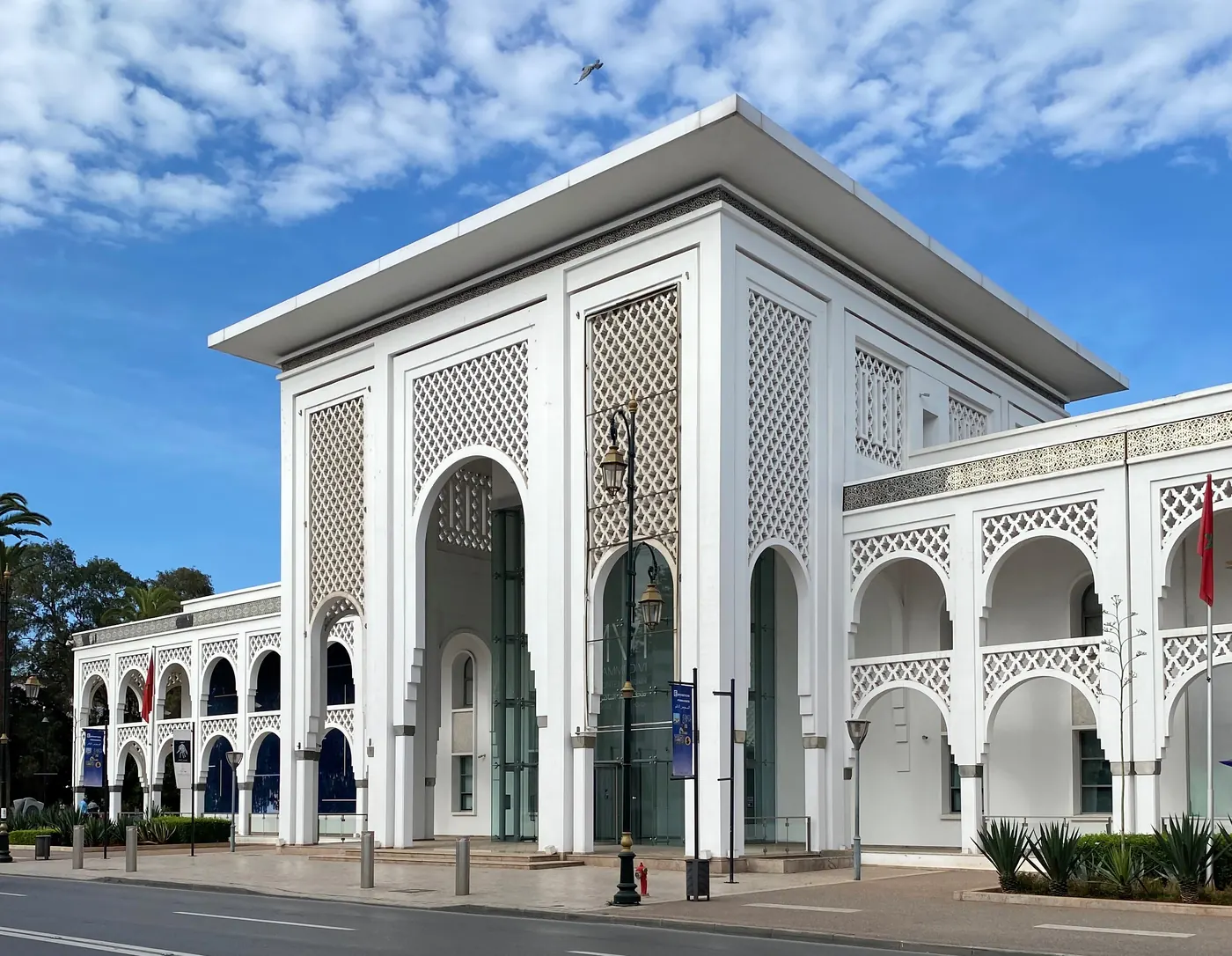
The official FNM record gives the address as 2 Avenue Moulay Hassan, Rabat.1 Put that full address into your map or show it to a driver rather than navigating to a loosely named cultural district. The two licensed photographs in this guide depict the museum building itself; they are not images of Hassan Tower, the Mausoleum of Mohammed V or another Rabat attraction.
If you are arriving by public transport, use the address as the destination and check the final walking route for your own starting point. Rabat–Salé Tramway publishes its current network map and timetable online, but neither source makes a specific museum stop a safe universal recommendation for every origin, line change or time of day.3
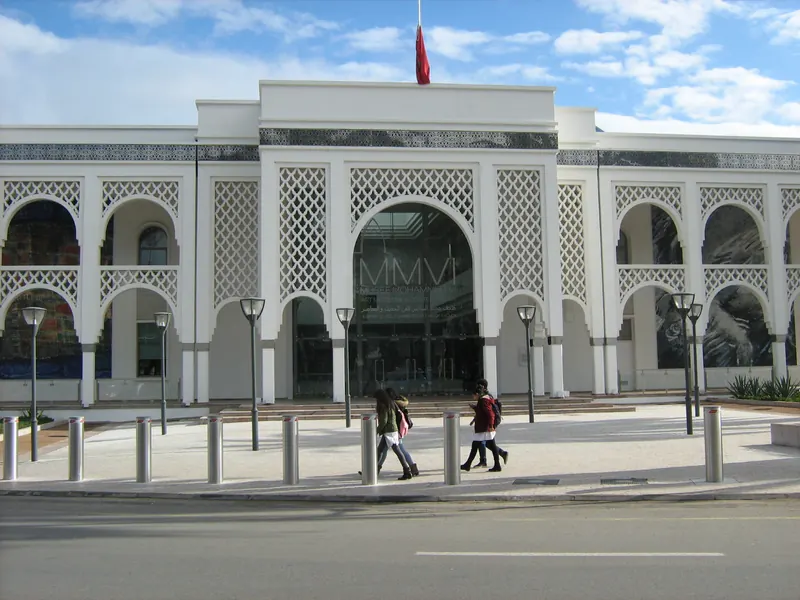
Resolve the official hours contradiction
The FNM museum page currently prints: “Ouvert du lundi au dimanche, de 10h à 18h. Fermé le mardi.” In English, that says open Monday through Sunday from 10:00 to 18:00, then says closed Tuesday. Those statements conflict. The page is useful evidence that FNM is actively publishing visitor information, but it is not a dependable day-by-day schedule as written.1
Do not treat either Tuesday access or a 10:00–18:00 visit as guaranteed. Before you leave, call the museum at +212 (0) 5 37 76 90 47 and ask whether it is open on your specific date, the last admission time and whether an event changes access. The FNM page supplies that telephone number, but it does not state a last-entry time.1
Treat listed prices as a pre-visit check
The FNM's public museum record lists the following tariffs. It does not say which exhibitions, guided services or special events are included, so use the table as a current reference point rather than a promise of your final charge.1
| Visitor category on the FNM page | Listed price | Confirm before paying |
|---|---|---|
| Moroccan adults | 30 DH | Date-specific entry, payment method and any exhibition conditions |
| Moroccans under 18 | 15 DH | Eligibility evidence and whether an accompanying adult is required |
| Foreign visitors | 60 DH | Availability, payment method and what the entry covers |
The page displays an “Acheter des billets” or “Buy tickets” control, but its published visitor details do not give a stable public booking URL. Do not assume that walk-in admission, an online slot or a third-party ticket listing applies to your date. Ask the museum whether pre-booking is offered and, if it is, request the official booking route directly.
Check today's art, not an old exhibition list
The museum's FNM description says that it stages temporary exhibitions alongside its collection and directs visitors to FNM's exhibitions catalogue.1 2 That is the right place to start, but a past page, social post or older travel guide is not proof that a particular show is still installed.
No current exhibition title is named here because the official material reviewed did not give an unambiguous, date-specific confirmation of what will be open on your visit. Check the FNM exhibition catalogue close to the date, then call if a specific artist or show is the reason for your trip. Ask whether it is at the Mohammed VI Museum, its final date, and whether it follows the same admission arrangement as the main galleries.
Ask these questions before leaving
The FNM museum record provides its address, phone number, hours line and price categories, but it does not publish a complete visitor policy for photography, bags, accessibility, parking, children or re-entry.1 Keep these as questions, not assumptions:
- Is the museum open on my date, and what is the last admission time?
- Which exhibition and collection galleries are available that day?
- Is photography allowed in the galleries, and are bags or large items restricted?
- Is there a step-free route, lift, seating, accessible toilet or other assistance that matters to my group?
- Is visitor parking available, and if so, where should a driver arrive or wait?
- Is an official online booking route available for my visitor category?
A concise call that names the date, number of visitors and any mobility or luggage need is more useful than relying on a generic “open” label. It also lets you change the order of your Rabat day before you are already outside the door.
Plan the arrival without guessing a stop
For a taxi or private driver, use the exact FNM address and agree on the pickup plan separately. If you are taking the tram, open the official Rabat–Salé network map and check the operator’s current timetable on the day, then choose the walking route that matches your actual starting point.3 Schedules, lines and the most convenient final approach can change; no fixed station or transfer time is claimed here.
Drivers should not infer parking from the museum's central address. The public FNM page does not state a visitor-parking arrangement, so call before deciding to use a car. Likewise, a traveller with a pushchair, wheelchair or limited walking tolerance should ask the museum about the entrance and route they will actually use rather than interpreting the building facade as evidence of indoor accessibility.
Fit it into a wider Rabat visit
Give the museum a flexible block rather than assigning a fixed duration from an old itinerary. Your time depends on the galleries open, the temporary exhibition, entry process and how deeply you want to look. If the call confirms a closure or makes the museum impractical for your schedule, use the city guide's alternatives instead of forcing an extra cross-town journey.
A useful sequence is to settle the museum's date, opening and exhibition first, then place it beside nearby parts of your personal Rabat plan. Do not use museum admission as a reason to skip a confirmed train, accommodation or other timed connection; museum arrangements remain set by FNM and may change independently.
For an outdoor heritage complement to an indoor museum visit, the Chellah visit guide explains its separate ticket, access and walking considerations. Treat the two as independent choices rather than assuming one fixed sightseeing sequence.
Get help with the moving parts
If you want help coordinating the questions for independent museums, transport providers and accommodation around a Rabat day, the Maroc Mobility Personal Travel Assistant can help organise the plan. FNM and other providers set their own availability, admission, booking and access terms, so confirm the final museum details directly with them.