The short answer
Spring and autumn are the simplest starting points for Agafay because they make an outdoor dinner, a short daylight visit or an overnight easier to plan. They are not a promise of still air or a warm night. For a fixed summer date, shift the experience toward early or late hours and do not build the day around exposed midday time. For a winter overnight, reserve only after the property answers how the room and dinner area are heated or sheltered.
This is a timing guide, not another choice between a day trip and overnight camp. First decide the experience you want; then use the season and exact forecast to decide whether it fits.
Choose a season by the experience, not one “best” month
The nearest long-term city climate is useful as a heat-and-cold signal, not as a promise for a specific camp. In Marrakesh, average highs reach 98°F (37°C) in July and August, while January’s average low is 44°F (7°C). 1 Agafay is outside the city, and its exposed setting, elevation, wind and individual camp layout can change how a particular hour feels. Historical climate datasets are also designed for broad patterns rather than a camp-by-camp forecast. 3
| Period | Usually the best fit | What can make it less comfortable | A sensible default |
|---|---|---|---|
| March to May | First-time day visitors, sunset dinners and flexible overnights | A warm spell, wind or a showery forecast | Book the format you want, then check the exact date before committing to a long outdoor programme. |
| June to September | A short early or late visit when your Marrakech itinerary is otherwise fixed | Strong sun and heat during an exposed afternoon | Choose shade and a shorter outdoor window; make the dinner or return time explicit. |
| October to November | Dinners, photography-focused visits and overnights with a comfort check | Cooler evenings, wind or an early rain spell | Pack a layer from the start and confirm where dinner moves if conditions change. |
| December to February | Daylight scenery or a dinner/overnight only when the property’s cold-weather setup suits you | Cold-feeling evenings, wind and rain on some dates | Prioritise a real room and sheltered dining over a vague “desert camp” label. |
There is no useful universal answer such as “Agafay is always best in October.” A calm April evening and a windy April evening call for different clothes and perhaps a different format. If your trip dates are fixed, the decision is usually not whether to cancel Agafay altogether; it is whether to choose a short visit, dinner, overnight, or a Marrakech-based alternative on that day. For wider route choices across the country, see the best time to travel to Morocco.
Match the time of day to your visit
A single day can contain the two conditions that matter most: direct sun before late afternoon and a much cooler, windier-feeling period after sunset. Pick the timing that serves your actual purpose.
| Visit format | Timing that usually makes sense | What to confirm before paying |
|---|---|---|
| Short daylight visit | Earlier or later in the day, especially in summer | Exact pickup and return window, shade at the base, water availability and how much standing or walking is involved. |
| Sunset dinner | Arrive with time to settle before dark, but do not assume the terrace stays comfortable | Whether dining is outdoors, partly sheltered or indoors; what happens if wind or rain changes the setup; and the night-return plan. |
| Overnight | The arrival-to-bed period matters as much as the next morning | Room heating or cooling, bathroom arrangement, bedding, walkway lighting, dining shelter and weather/cancellation terms. |
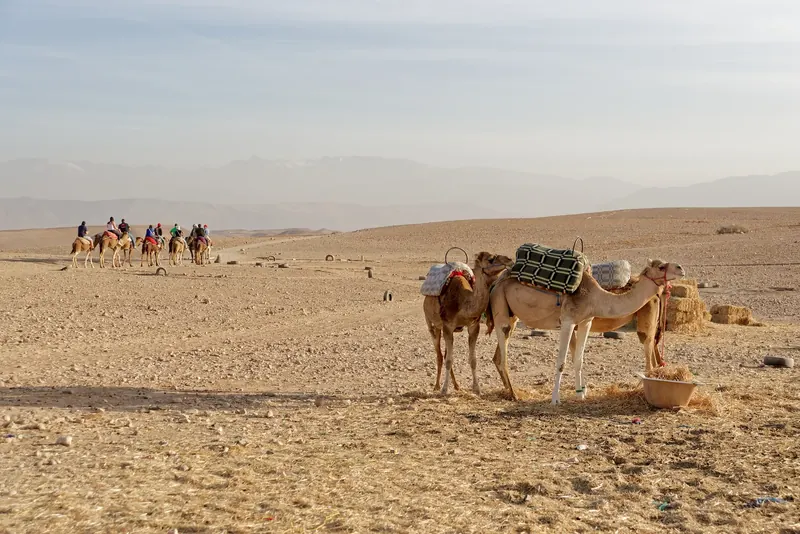
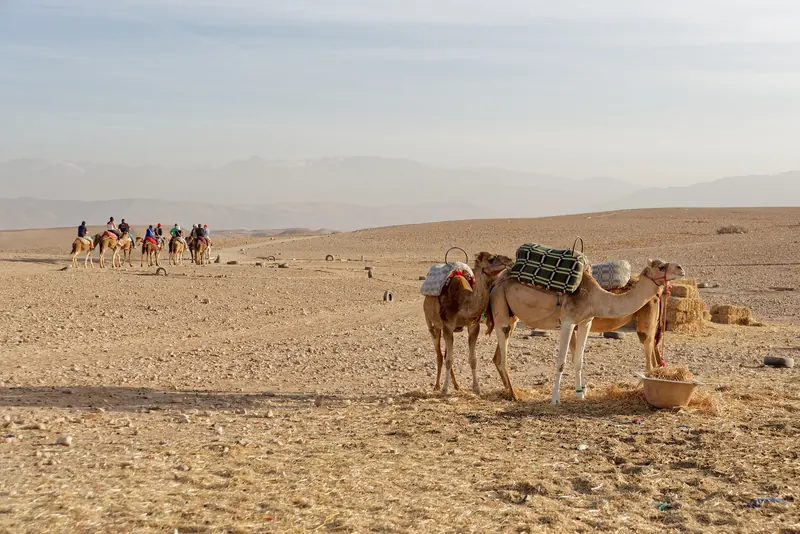
The supporting image below shows open Agafay terrain and dromedaries, not a specific camp or booked activity. If a camel activity is part of your plan, ask the provider how long it runs, whether it is scheduled in the exposed part of the day, and whether you can choose a camp-only alternative.
Summer: reduce exposure instead of chasing a perfect forecast
A clear summer forecast may be good for visibility but still be a poor match for a long, unshaded programme. The nearby Marrakesh climate record describes a hot season from late June to early September, with average daily highs above 93°F (34°C). 1 That supports a simple planning rule: keep the most exposed part of an Agafay day short, and make shade, water and an air-conditioned return vehicle part of the practical plan rather than optional extras.
The CDC advises that UV exposure is highest around 10 a.m. to 4 p.m., particularly in summer, and recommends shade, protective clothing, a wide-brimmed hat, sunglasses, broad-spectrum sunscreen and non-alcoholic fluids. 2 Those are general travel-health measures, not proof that a particular Agafay date will be unsafe. They are most useful when a forecast and your own heat tolerance make an outdoor activity less appealing.
A better summer alternative may be a later dinner with a confirmed sheltered seating plan, or another Marrakech activity during the hottest part of the day. Do not assume a pool, shaded lounge, air conditioning or a particular activity is included: those are supplier policies, and each property’s operation can change by date.
Winter and unsettled dates: assess the overnight separately
Winter daylight can suit a short Agafay escape. The weak point is often the period after sunset, when an open dinner or a tent-like room may feel very different from afternoon conditions. Ask the property for a direct answer, not a marketing adjective: “Is our booked room heated?” and “Where will dinner be served if it is windy or raining?”
If rain, strong wind or a storm is in the forecast, ask whether the transfer still runs, whether outdoor activities are optional or cancelled, whether there is sheltered communal space, and what the cancellation or date-change terms actually say. Those are contract terms set by the supplier; they are not Morocco-wide rules. If the answers are vague, a Marrakech evening and a rebooked Agafay visit may be the lower-stress choice.
Use a 48–72 hour comfort check
When booking weeks ahead, use the season to choose a broadly suitable format. Then make the final call closer to departure. The World Meteorological Organization’s World Weather Information Service provides official forecast routes by country and city; pair a nearby forecast with the camp’s exact pin and its written conditions. 4
Use this short sequence:
- Read the forecast for the visit window, not only the daily icon. Compare the expected temperature, wind and chance of rain around arrival, dinner and departure.
- Send one specific message to the booked provider. Ask whether your exact room, dinner area, transfer and any activity will run as planned in those conditions.
- Decide what you will trade off. In heat, shorten outdoor time. In a cold or windy evening, favour indoor or sheltered dining. In uncertain rain, keep a Marrakech alternative.
- Save the answer and the terms. A verbal “no problem” is not as useful as a message that identifies the room, pickup, meal setting and cancellation option.
This is also the point to settle transport. A late outdoor dinner only works if the return is clear after dark; use this Marrakech-to-Agafay transport guide when deciding between a transfer, taxi, tour or self-drive.
A simple decision rule
- Choosing dates now: Prefer spring or autumn if Agafay is a priority and you want the most flexibility between a day visit, sunset dinner and overnight.
- Visiting in summer: Keep the experience short and timed away from the exposed middle of the day; book only the shade and return details you can verify.
- Visiting in winter: A daylight visit is the low-commitment option. For an overnight, pay for the actual room and cold-weather arrangement you have confirmed.
- Seeing an unfavourable short-range forecast: Change the format or date rather than assuming an outdoor plan will feel like the promotional photos.
For help coordinating those independent-provider questions around an exact-date Morocco plan, see Maroc Mobility’s Personal Travel Assistant. Bookings, facilities and weather terms remain with the relevant provider.