Should you visit the Tangier American Legation?
Yes—if you want a small, historically specific museum stop while exploring Tangier’s old city. The Legation was given to the United States by Morocco’s Sultan in 1821 and served as a U.S. diplomatic mission for more than 140 years. It is now a museum, research and cultural center, and the official history describes it as the only U.S. National Historic Landmark outside the United States. 2
That makes it a better choice for visitors curious about Moroccan-American connections, historic interiors, maps and art than for someone seeking a large collection arranged as a conventional national museum. The U.S. National Museum of American Diplomacy also describes the building as an evolving complex around a neo-Moorish courtyard, which helps explain why the architecture is part of the visit rather than just the setting. 4
Choose the Legation as one meaningful indoor stop in a medina day. If your schedule is very tight, do not assume a quick photograph will reveal its point: the historical rooms and collection context are the reason to go. Conversely, do not plan the day around an assumed visit duration. The official visitor information gives hours and entry details, but does not prescribe how long a self-guided visit takes. 1
Current hours, entry and location
The official visitor page lists these hours:
- Monday to Friday: 10:00–17:00
- Saturday and Sunday: 10:00–15:00
- Entry: 20 MAD for residents and 50 MAD for non-residents
- Address: 8 Rue d’Amérique, Tangier 1
Treat those as the current published terms, not an unconditional promise for a future date. Check the venue’s visitor information again before you leave, especially on a public holiday, around a special event, or when a closing time affects an onward plan. The page includes an official map link; save it offline if you are navigating the medina without data. 1
The published fee is useful, but several practical details are not stated there. It does not say what evidence a visitor must show for the resident rate, whether there is a child or student rate, whether cards are accepted, or whether ordinary admission requires advance booking. Do not turn an omission into a promise. If any of those details matters, ask before travelling to the door. 1 5
Tours and a low-stress arrival plan
The Legation asks visitors to contact [email protected] to schedule a guided tour. That is the route to take if interpretation, a group visit, or a fixed itinerary makes a tour important. The site does not publish a standard tour length, language, price, minimum group size, or availability calendar, so request those specifics directly rather than assuming a guide is available at the entrance. 1 5
For an independent visit, a simple plan is more reliable than a tightly packed one:
- Recheck the official hours and admission page on the morning of the visit.
- Save 8 Rue d’Amérique and the official directions link; a museum address inside the medina is more useful than a vague neighborhood search.
- Decide whether the museum itself is the priority or whether a pre-arranged guided tour is worth the extra coordination.
- Leave enough buffer before closing to find the entrance and look through the rooms without making a later reservation depend on an exact exit time.
No visitor-parking or vehicle-drop-off instructions are published on the museum’s visitor page. If you are arriving by car, taxi, or with luggage, ask your driver or accommodation for a sensible nearby handoff instead of planning to pull up at the museum door. 1
What to expect inside
The value is in the combination of place and collection. The official permanent-exhibits page lists galleries and installations including Americans in Morocco, the Angus and Forbes galleries, Crossroads, Lives of the Legation, and a dining room. 3 The collection highlights include historic maps as well as works associated with artists such as James McBey, Hassan El Glaoui and Mohammed ben Ali R’bati. 3
Use that list as a guide to the museum’s range, not as a guarantee that a particular item will be on view on your date. Displays, temporary exhibitions, events and room access can change. If there is one artist, subject, or temporary program you particularly want to see, check the museum’s current exhibition information or contact the curator before building the day around it. 1 3 5
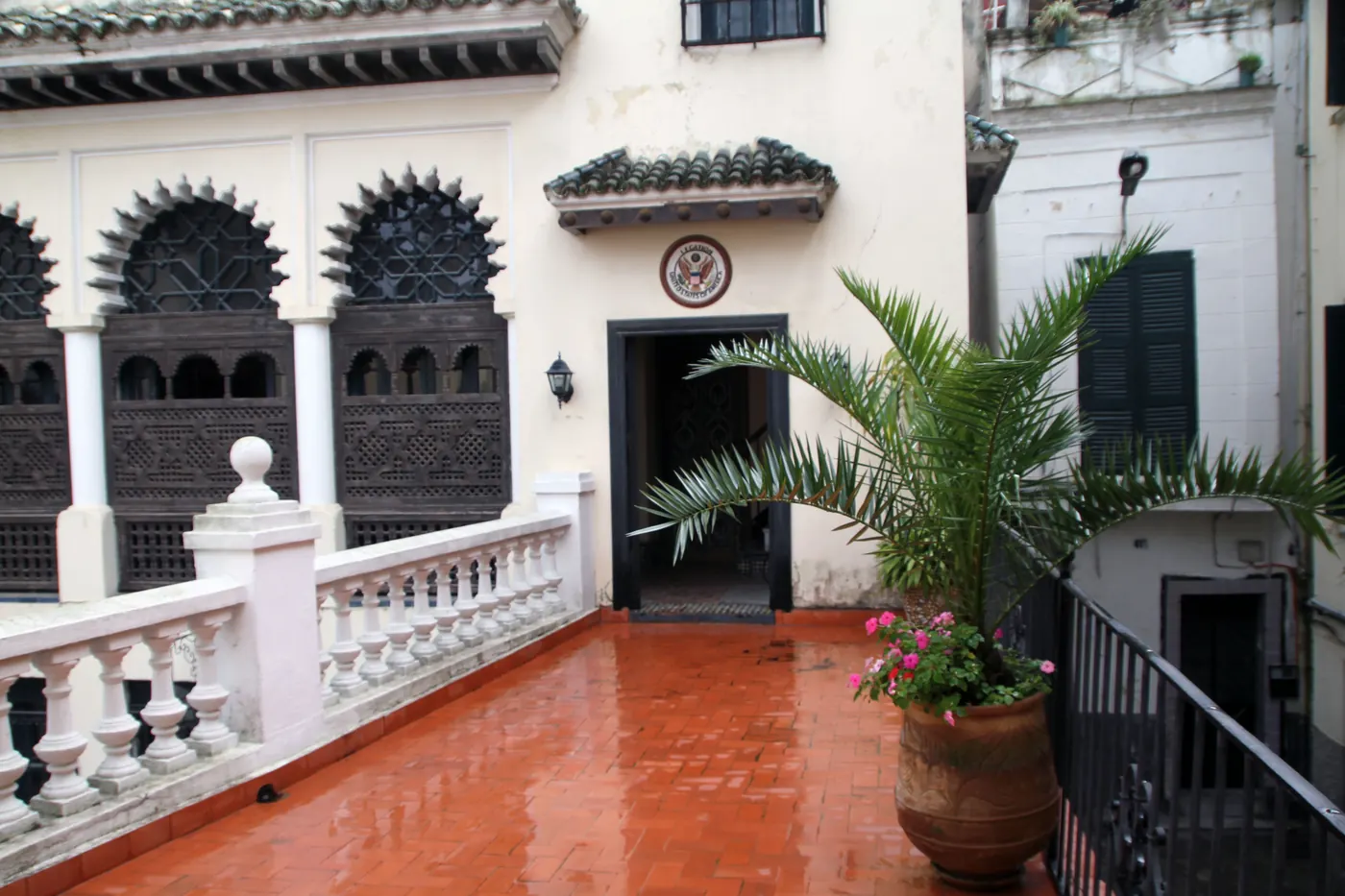
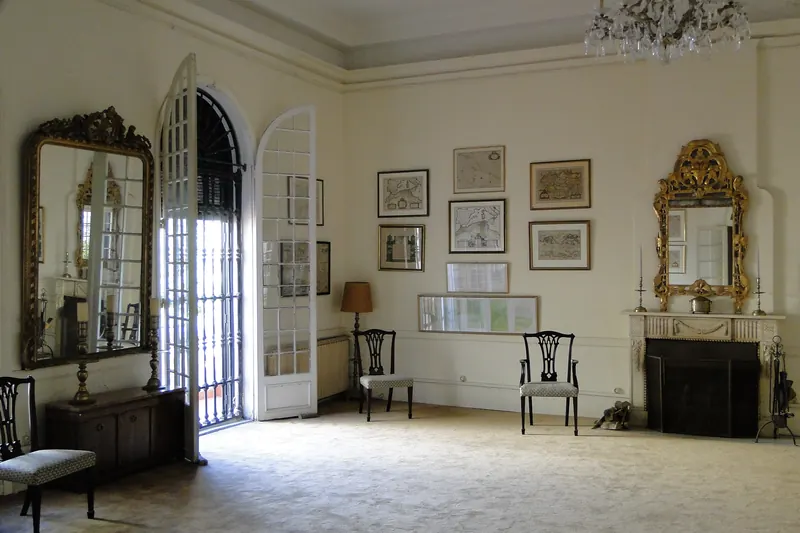
The supporting image in this guide shows a historic reception room photographed in 2010. It is a useful sense of the building’s domestic-scale interiors, not evidence that every furnishing, display or route will look identical during a future visit.
Fit the Legation into a Tangier day
Think of the Legation as an old-medina cultural pause, not a separate excursion requiring a full day. It works well when you want to break up walking with a museum visit and then continue on foot through the medina. Because the official directions place it at 8 Rue d’Amérique, use the address and live route on the day instead of estimating a route from a landmark. 1
A good decision rule is to pick one main indoor cultural stop and allow the rest of the day to stay flexible. If you are also considering the Kasbah Museum, cafés, the Grand Socco, or a waterfront walk, see our first-time Tangier sightseeing guide for the wider one- or two-day trade-offs. It is better to see one museum with time to read and look than to stack several admission windows that leave no allowance for medina navigation.
If your Tangier day begins after a ferry arrival, keep the museum plan conditional on your actual arrival time and baggage handoff; the Tangier ferry onward-travel guide explains why Tanger Med and central Tangier are separate logistics decisions.
If this museum is a priority, let the overnight base support the way you want to begin and end the day. Where to stay in Tangier compares the Medina, centre, Corniche and Malabata without assuming a particular attraction sequence.
Families, access and policies to confirm
The official visitor information gives hours, prices, address and a guided-tour contact, but does not publish an age policy, children’s price, family facilities, stroller guidance, or a minimum age for a visit. A family can decide whether the history, rooms and art suit its own children, then email the curator with any need that could change the plan. 1 5
For accessibility, the visitor page displays lower- and upper-level maps but does not provide a detailed statement on a step-free route, lift, adapted toilet, seating, entrance threshold, or assistance. That absence is not evidence that none is available; it is a reason to ask for a direct answer before making a special journey. Share the mobility aid or stroller you plan to use, whether steps are manageable, and whether you need a particular entrance or toilet arrangement. 1 5
The same caution applies to photography, bags, dress, food or drink, and payment. The visitor page does not set out rules for those points. Dress comfortably and respectfully for a museum in the medina, but do not present that as a published dress code; ask staff before taking photographs or relying on a particular payment method. 1
A practical final check
Before setting out, confirm the current day and hours, use the official address, and decide whether a self-guided visit or an arranged tour best matches your interests. Then send one concise enquiry if a policy gap could spoil the plan: accessibility, a child’s admission, a tour, photography, cards versus cash, or an event-day closure. The museum itself—not a directory listing—should give the final answer. 1 5
If you want help fitting the visit around your arrival, other Tangier plans, or travel-day timing, Maroc Mobility’s Personal Travel Assistant service can help coordinate a personal Morocco itinerary. Admission, guided tours, and all venue policies remain set and confirmed directly by the Tangier American Legation.