First: adapter or converter?
For Morocco, start with the label on each charger—not with the country printed on the plug. Morocco uses round-pin Type C and Type E sockets at 50 Hz. Travel references describe its supply as either 220 V or 230 V, so the safe travel-planning comparison is 220–240 V, 50 Hz. 1 2
If the device’s input rating covers that range and 50 Hz, buy a plug adapter that fits Type C/E sockets. If the input rating is limited to 100–120 V, do not connect it using only a plug adapter. A travel adapter changes the plug shape; it does not convert voltage or frequency. 5
Use this quick test before packing:
- Find the word INPUT on the charger, power brick, appliance base or manufacturer documentation.
- If it includes 220–240 V and 50 Hz—commonly written
100–240 V ~ 50/60 Hz—pack an adapter only. - If it says 100–120 V only, do not use it in Morocco unless its manufacturer says a suitable converter can be used.
- If the rating is missing or unclear, use a different device or ask the manufacturer before travel.
Choose a plug adapter for Type C and Type E
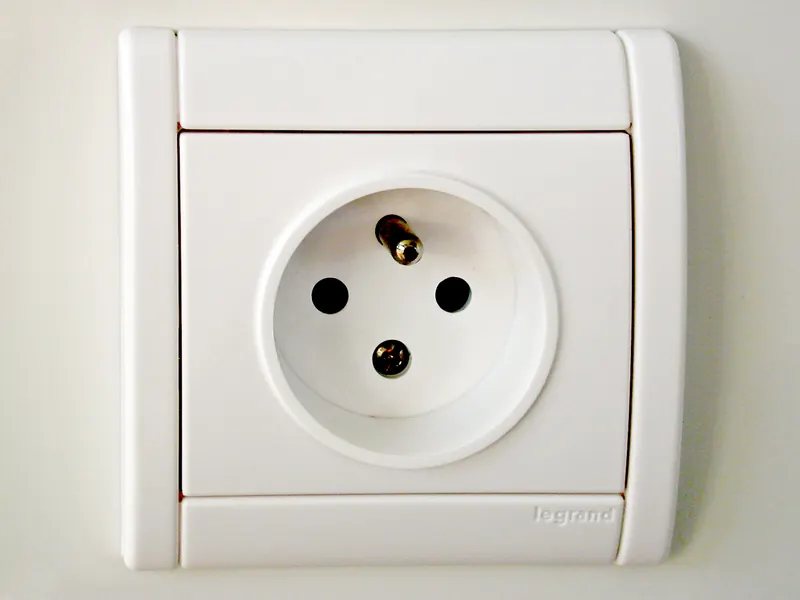
Type C is the small, ungrounded two-round-pin format. Type E also has two round power contacts, but its socket has a protruding earth pin. A Type C plug fits a Type E socket. A grounded CEE 7/7 E/F plug has the matching opening for that earth pin and is compatible with Type E. 3
That distinction matters for an appliance that needs an earth connection. Do not assume that a small two-pin adapter is suitable just because it physically enters the socket. Choose an adapter designed for the appliance’s home plug, stated load and grounding requirements; it should preserve the earth connection where the appliance requires one.
For travellers from the UK or Ireland, a Type G plug needs a physical adapter even though those countries also use a 50 Hz, roughly 220–240 V supply. For travellers from the United States or Canada, the plug shape needs an adapter and every power supply needs the input-label test. Travellers carrying a simple Type C Europlug may already have a physical fit; a grounded European E/F plug relies on finding a Type E socket. Because rooms and properties can vary, do not rely on a particular socket layout without a backup plan for essential equipment.
Read the input label, not the output
A dual-voltage power supply normally shows a range such as:
INPUT: 100–240 V ~ 50/60 Hz
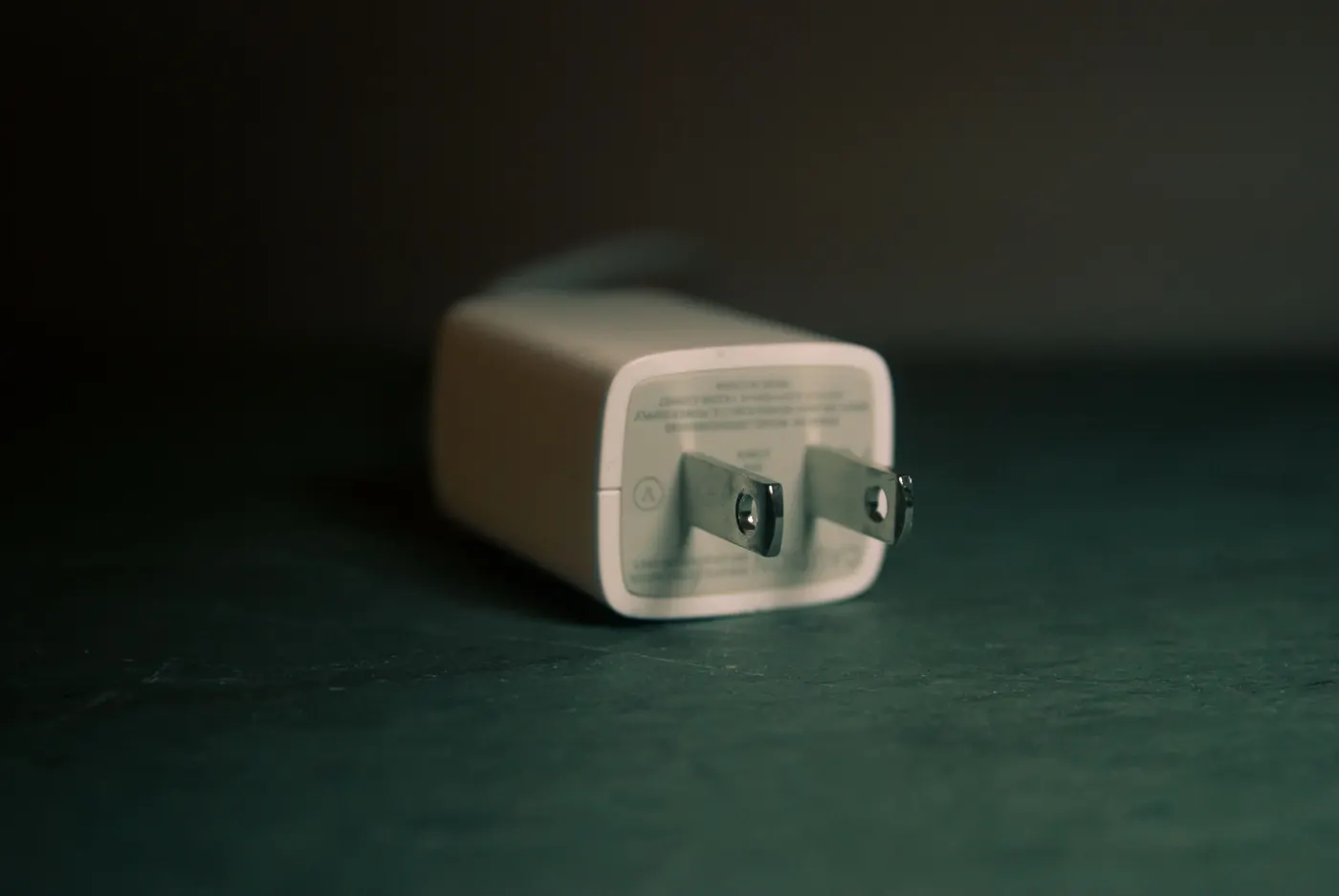
That range includes Morocco’s supply, so the device needs only a plug-shape adapter. Apple, for example, specifies 100–240 V AC at 50–60 Hz for its USB power adapters; treat that as an example of what to look for on the specific charger you own, not as proof that every charger has the same rating. 4
Do not use the output line to make this decision. A line such as Output: 5 V describes what the charger sends to a phone or other device; the wall-socket compatibility is determined by the input line. Check separate power bricks individually: a laptop charger, camera battery charger and electric toothbrush base can have different ratings.
A multi-port USB charger can reduce the number of wall chargers you pack, but it still needs an input rating that covers 220–240 V and 50 Hz. Its USB ports do not make an incompatible wall input safe.
When a converter is genuinely needed
A voltage converter or transformer is a separate piece of equipment. Consider one only for an appliance whose input rating does not cover Morocco’s supply and whose manufacturer permits converter use. Then check the converter’s stated input, output, frequency limitations and maximum continuous power rating against the appliance. Electrical Safety First notes that converters and transformers have maximum ratings, and that a frequency mismatch can affect how some appliances operate. 5
Do not treat a converter as a universal solution for a high-demand appliance, a motorised item, a heating item or essential medical equipment. If the manufacturer does not give clear international-use instructions, the lower-risk choice is to bring a dual-voltage alternative or arrange a compatible appliance locally. A historical CPSC recall of a dual-wattage travel converter illustrates why a setting and load must match: the recalled model could overheat when more than 50 W was used on its 50 W setting. 6
A compact packing setup
For a phone, camera and laptop trip, take the equipment you have verified rather than buying a converter “just in case.” A practical setup is one suitable C/E adapter, each device’s correctly rated charger, and a short list or phone photo of the input labels. Keep the adapter accessible for the first night rather than in checked luggage.
Before leaving, confirm these points:
- The adapter accepts your home-country plug and is appropriate for the appliance’s stated load.
- A grounded appliance has an adapter that maintains the required earth connection.
- Every wall-powered charger has an input rating covering 220–240 V and 50 Hz.
- You have the right charging cables as well as the adapter.
- Your phone has an offline map and a charging plan; see the Morocco SIM and eSIM guide for the connectivity choice, and add the verified setup to your wider Morocco packing list.
For broader arrival, route or booking coordination, see how the Personal Travel Assistant can support a Morocco trip.